The World Manuscripts
of the Life of Saint Mar Okeen
From Arabic Manuscript 297 at the Monastery of the Syrians to the Syriac witnesses in the libraries of the world
An illustrated documentary study of the history of the text, its catalogues and its witnesses, including the new cataloguing information on the Arabic copy supplied directly by Professor Stephen J. Davis, with the open questions set out clearly.
1. Introduction: why gather these witnesses?
This study is offered in service of readers and researchers of the history of Saint Mar Okeen, making the sources, manuscripts and references clearly available, without highlighting the names of those who run the site.
The Life of Saint Mar Okeen (Mar Awgin, Mar Awgen, ܐܘܓܝܢ) preserves the story of an Egyptian monk whom the Church's tradition connects with Mount Izla near Nisibis and with the spread of monastic life in Mesopotamia.
This small book concentrates on a question distinct from telling the story of the Life: where are its manuscript texts to be found? And how do we distinguish the time of the events in the narrative from the time when the copy in our hands was written? And what relationship might there be between the Arabic text in the library of the Monastery of the Syrians and the Syriac witnesses preserved in other collections?
The page the Life of the saint affirms the tradition of Clysma, pearl diving, the monastic life and the journey to the East; this study presents these as the content of the transmitted narrative, not as independent evidence of when it was written. [1]
2. Arabic Manuscript 297: the Monastery of the Syrians
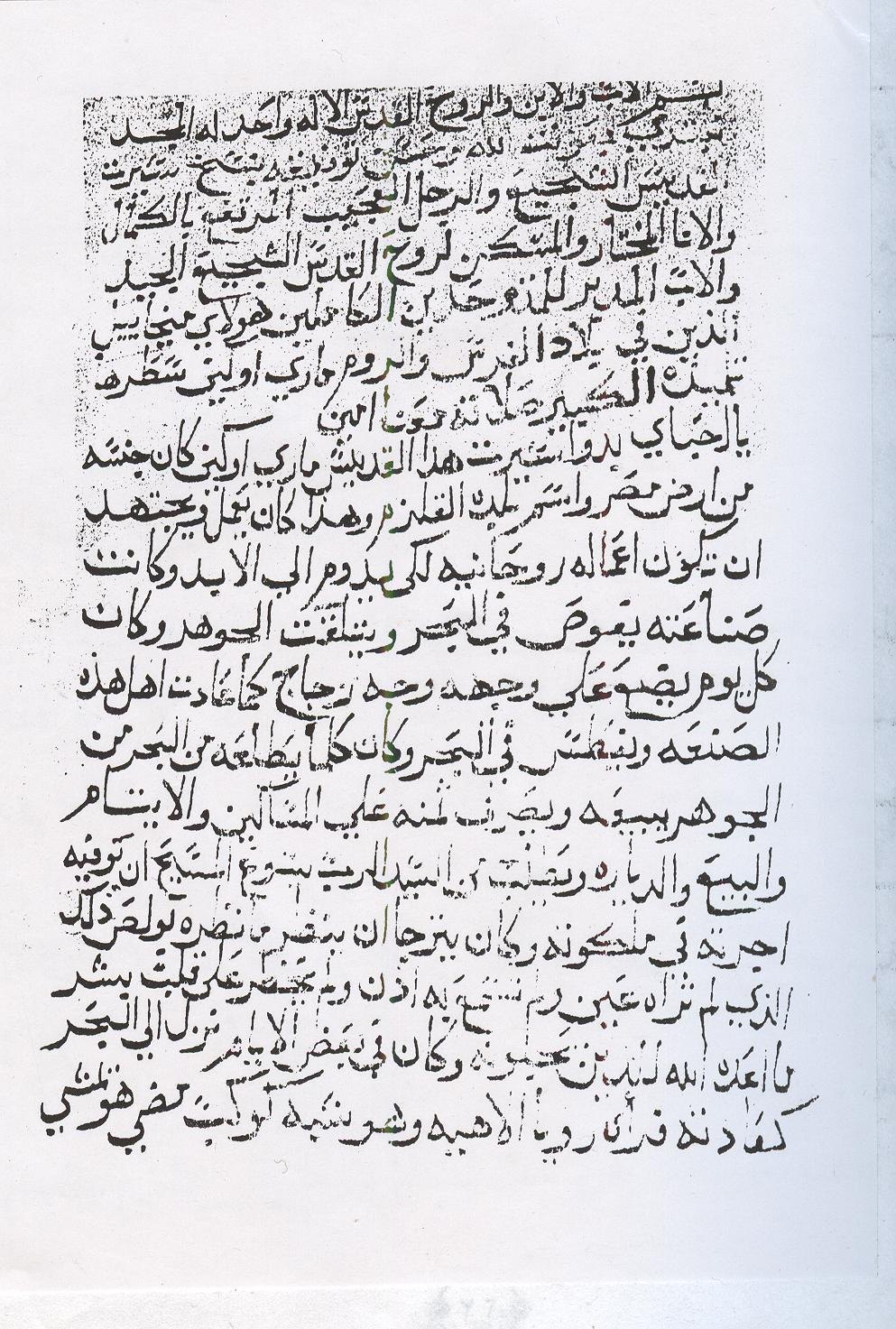
In his letter of 9 November 2026, Dr Stephen J. Davis identified the manuscript precisely: Dayr al-Suryān, MS 297, older number 13 Mayāmir, modern catalogue number DS Arabic Mayāmir 96. It is an Arabic collection containing eleven Lives of saints. The Life of Mar Okeen, attributed to his disciple Michael, occupies folios 3a–40b, and its ending is missing. A Life in Arabic based on the manuscript was published in Anba Matthaeus's book in 2006. [2][23]
Language, script and date
The language is Arabic. Dr Davis recorded two dates in the colophons after the fourth and fifth Lives of the collection: 16 and 17 Baramhat, Year of the Martyrs 1054, on folios 89a and 98b. In his view the collection was most likely completed shortly afterwards. The correct Common Era conversion of the two dates is 1338 CE, as he confirmed in his letter of 10 November 2026; the figure 1334 CE in the draft catalogue was a typographical error. [23][27]
What has the Yale project added?
The Yale University project describes the old catalogues of the Monastery of the Syrians and their numbering systems, while Dr Davis's recent letter supplied a direct and confirmed concordance of three numbers for this manuscript: 297 / 13 Mayāmir / DS Arabic Mayāmir 96. The detailed description is expected to appear in volume five of the catalogue series, which, as Dr Davis explained, has been in press for nearly two years and is still awaiting publication. [3][23]
The approximate copying date and the concordance of catalogue numbers are no longer unknown. But the name of the scribe, the original place of copying, and the relationship of the Arabic text to the Syriac recension remain unestablished. The Life of Mar Okeen is attributed to Michael in the manuscript, but this does not identify the scribe. [23]
3. A new scholarly document: the reply of Dr Stephen J. Davis (9 November 2026)
On 9 November 2026 the okeen.net project received a direct reply from Dr Stephen J. Davis, Professor of Religious Studies and History at Yale University, dealing specifically with Monastery of the Syrians Manuscript 297, which brings together eleven Lives. These are the first detailed, dated data we have received about the copy itself. [23]
A. The numbers and the copying date
The manuscript's identity is confirmed by three shelf numbers: 297 (shelf number), 13 Mayāmir (older number), and DS Arabic Mayāmir 96 (new scholarly catalogue number). The scholar recorded two colophons, on folios 89a and 98b, which record the completion of the fourth and fifth Lives on 16 and 17 Baramhat, Year of the Martyrs 1054. In his view the copying of the collection was completed a short time after them. This is a date for the copying of the collection, not for the composition of the original Life of Mar Okeen or for the time of its events. [23]
Correction documented on 10 November 2026: Dr Davis confirmed that Baramhat in the Year of the Martyrs 1054 corresponds to 1338 CE, and that the figure 1334 CE that appeared in the earlier draft of the volume was a typographical error. This settles the discrepancy in the Common Era conversion. [27]
B. The name of the author and the state of the Life of Mar Okeen
The collection has no known scribe. The first Life, however, is attributed within the manuscript to Michael (Mīkhā’īl), the disciple of Saint Mar Okeen. The Life occupies folios 3a–40b, and its ending is missing. Its Arabic conclusion therefore cannot be compared with the conclusion of the Syriac text published by Bedjan as though the text were fully preserved in 297. [23]
C. The history of the manuscript in the monastery library
The exemplar from which the manuscript was copied, and the place where it was first copied, are unknown. But the endowment statement is written in a hand that Dr Davis identified as that of Yuhanna al-Fayyumi (Yūḥannā al-Fayyūmī), who served as librarian of the Monastery of the Syrians in the late eighteenth or early nineteenth century. We therefore know that the manuscript was in the monastery library by that period at the latest. Yuhanna does not give his name in this endowment statement; the attribution of the hand to him rests on comparison with other manuscripts in the collection. [23]
D. The relationship of the Arabic text to the Syriac manuscripts
Dr Davis explained that he has no evidence of a direct textual link between the Arabic copy 297 and the older Syriac texts. The collection includes Lives connected with Syria and Lives of Coptic saints. Linking the Arabic copy to any particular Syriac witness remains an open question for textual criticism. [23]
E. The complete contents of the manuscript (11 Lives)
| No. | Title of the Life, as catalogued by Dr Davis | Folios | Condition |
|---|---|---|---|
| 1 | Life of Mar Okeen (Eugene), attributed to his disciple Michael | 3a–40b | Ending missing |
| 2 | Life of Mar Malka (Mār Malkā) | 60a | Only the last folio survives |
| 3 | Life of Mar Isaiah (Mār Sha‘yā’ / Isha‘yā’), disciple of Mar Okeen | 60b–76b | No loss noted |
| 4 | Life of Mar Yarit of Alexandria (Mār Yārit) | 77a–89a | Dated colophon on 89a |
| 5 | Life of Mar Habib (Mār Ḥabīb), bishop and disciple of Mar Okeen | 89b–98b | Dated colophon on 98b |
| 6 | Life of Mar Basyana the Copt (Mār Basyānā al-Qibṭī), disciple of Mar Okeen | 99a–112b | No loss noted |
| 7 | Life of Mar Jacob, Metropolitan of Nisibis | 113a–117a | No loss noted |
| 8 | Life of Mar Ephrem the Syrian, disciple of Mar Jacob | 117b–133a | No loss noted |
| 9 | Life of Mar Jacob, Bishop of Serugh | 133b–134a | No loss noted |
| 10 | Life of Mar Awlagh the Copt (Mār Awlāgh al-Qibṭī), disciple of Mar Okeen | 134b–151b | No loss noted |
| 11 | Life of Mar Behnam, son of Sennacherib the Persian king | 152a–159b | Ending missing |
How to read the folio numbers: 3a means the front (recto) of the third folio, and 3b its back (verso). The absence of folios 41–59 from this list does not by itself show whether they are lost or contained another text that has not been described. [23]
F. Publishing the data and respecting the monastery's rights
The monastery did not permit Dr Davis to share images, and he observed this explicitly in his letter. This book therefore publishes a summary of the scholarly data in the letter, attributed to him and dated, without republishing manuscript images from the scholar's correspondence or claiming that this book is the official catalogue entry. The publication of volume five is awaited for the final reference to the published entry. [23]
4. The final clarification from Yale University: the date 1338 and the age of the copy (10 November 2026)
Professor Stephen J. Davis answered three supplementary questions about the date of Manuscript 297, the source of its dates, and the identity of Michael. This reply is an important complement to the earlier cataloguing data, not a new text from the manuscript itself. [27]
A. Establishing the correct Common Era date
Dr Davis confirmed that the equivalence given in the first letter between the Coptic year 1054 of the Martyrs and 1334 CE arose from a typographical error in an older draft of the catalogue volume, and explained that the correct conversion for the month of Baramhat is 1338 CE. In this edition we therefore adopt the date 1338 CE for the two dates recorded in the colophons of the fourth and fifth Lives, on folios 89a and 98b. The two references are to 16 and 17 Baramhat. This alone does not show the day on which the copying of the whole volume was finished; rather, it suggests the volume was completed in a period close to these two dates. [23][27]
B. Were old dates copied into a later copy?
Dr Davis considers this explanation unlikely in the case of Manuscript 297. He noted that carrying an old date over into a later manuscript is not a common case in what he knows of the collection of the Monastery of the Syrians, and that the type of paper is consistent with a fourteenth-century date. This is independent material evidence supporting the dating of the surviving copy, but it is not a report of laboratory analysis of the paper, and it does not identify the scribe or the place of copying. [27]
C. What have we learned about Michael?
Dr Davis explained that the team recorded no additional information about Michael, and that he did not have access to the manuscript at the time of writing his reply. The attribution of the Life to Michael, disciple of Mar Okeen, therefore remains part of the description of the text, while Michael's full name, the time of his life and his relationship to Michael of Amida require independent sources and new investigation. The fact that no further details were recorded should not be taken as evidence that they are absent from every other witness. [23][27]
| Question | Result after the letter of 10 November |
|---|---|
| The date Baramhat 1054 of the Martyrs | 1338 CE, as confirmed by Professor Davis; 1334 CE was a typographical error in the draft |
| Was the copy made later while keeping an old date? | An unlikely explanation; the type of paper fits the fourteenth century |
| Has any further account of Michael come to light? | The cataloguing team recorded no other data about him |
| The oldest origin of the Life and the date of its composition | Both still undetermined; the date of copy 297 is not the date of the original text |
Documentary integrity: this chapter attributes the substance of the reply to private scholarly correspondence dated 10 November 2026. No screenshot of the email, no contact details and no full text of the letter have been published, and no further manuscript images from the monastery have been published without permission. [27]
5. Hegumen Yuhanna al-Fayyumi and the preservation of Manuscript 297
The study of the history of manuscripts helps distinguish between the author of a text, the scribe of a volume, and the person who endowed it to the library or wrote its deed of endowment. In Arabic Manuscript 297 the name of the original scribe is not known, while Professor Stephen J. Davis was able to identify the hand in which the deed of endowment was written.
A. What do we know directly from the cataloguing of Manuscript 297?
In his research letter to the management of okeen.net dated 9 November 2026, Dr Davis stated that the manuscript's deed of endowment was written in a distinctive hand that the cataloguing team attributes to Yuhanna al-Fayyumi (Yūḥannā al-Fayyūmī), who was connected with the monastery library in the late eighteenth and early nineteenth centuries. The writer did not sign his name in the deed itself; the identification comes from the team's familiarity with his hand in other manuscripts of the collection. The more precise expression is therefore: "the deed of endowment is attributed to the hand of Yuhanna al-Fayyumi on the basis of palaeographic comparison", not "the deed is signed with his name." [23]
Dr Davis's statement establishes that the manuscript was in the library of the Monastery of the Syrians by that period at the latest, but it does not establish where it was copied in the fourteenth century, nor how it came to the monastery.
B. Hegumen Yuhanna al-Fayyumi in academic scholarship
The study Coptic Prayer Books in Ottoman Egypt by Arsenius Mikhail and Arsany Paul, in the journal Ex Fonte, volume 5 (2026), publishes documented information about Hegumen Yuhanna al-Fayyumi, head of the Monastery of the Syrians from 1796 to 1830. The study reports that his name appears in at least 40 manuscripts of the non-liturgical collection, usually as patron, donor or restorer, and that the liturgical collection shows his name connected with 28 further manuscripts. The two figures should not be added together as a final count of all the manuscripts without reviewing the boundaries of the two collections. [25, pp. 452–453]
| Manuscript | Date | Role of Yuhanna al-Fayyumi according to the study |
|---|---|---|
| Suryān Commentaries 97 | 1795 | Scribe |
| Suryān Liturgy 458 | 1794 | Scribe of the book of secret (mystagogical) prayers |
| Suryān Liturgy 459 | 1788 | Patron of the manuscript |
| Suryān Liturgy 461 | 1795 | Patron of the manuscript |
The study refers to an earlier piece of research by Fr Bigoul el-Souriany on the relationship between the Fayoum and the Monastery of the Syrians; according to his account, Yuhanna probably entered the monastery in the 1770s and learned copying and binding from Hegumen Qultah, before becoming head of the monastery. These details of his early life are presented in the 2026 study on the basis of the earlier research; they are not drawn from Manuscript 297 itself. [25, p. 453; 26]
C. Could another Yuhanna al-Fayyumi be meant?
In principle, yes: the name "Yuhanna" is common, and "al-Fayyumi" refers to a region. A match of name alone is therefore not enough to establish identity. But in this case the attribution does not rest on the bare name; it rests on the specialist palaeographic comparison mentioned by Dr Davis, together with what we know independently of the activity of Hegumen Yuhanna al-Fayyumi in the monastery library during the same period. Publishing an image of the deed of endowment, or a documented comparison of handwriting samples, remains subject to the permission of the monastery library.
D. Three periods that should not be confused
| Period | What does it mean? |
|---|---|
| The fourteenth century CE | The approximate date of copying of the Arabic collection, based on two colophons dated to the year 1054 of the Martyrs; Dr Davis confirmed that the correct conversion is 1338 CE and that 1334 CE was a typographical error in an earlier draft. [27] [23–24] |
| Late eighteenth to early nineteenth century | The period to which the deed of endowment in the hand of Yuhanna al-Fayyumi is attributed. It is evidence that the volume was kept at the monastery, not of the date of the Life's composition or of its original copying. [23] |
| 2026 | The date of the new academic study documenting the activity of Yuhanna al-Fayyumi in the monastery's manuscript collection. [25] |
Scholarly wording adopted for this study: Professor Stephen J. Davis attributes the hand of the deed of endowment of Arabic Manuscript 297 to Yuhanna al-Fayyumi, on the basis of comparison with his known hand in other manuscripts at the Monastery of the Syrians. The published historical context on Hegumen Yuhanna al-Fayyumi, head of the monastery (1796–1830), supports this attribution. But the writer's name does not appear explicitly in the deed, and Yuhanna may not be regarded as the scribe of the original manuscript or as the author of the Life of Mar Okeen.
6. The Syriac Life and the name of Michael
The Syriaca.org database records the Life of the saint under the identifiers BHS 87 / BHO 121, and in its author data attributes it to Michael of Amida. It gives the opening of the text, its conclusion, and a list of the manuscript witnesses and editions. [4]
The sense of the opening of the Life in the Syriac witness: "And so, my beloved, this is the Life of Saint Mar Awgin; by lineage, origin and homeland he was from the land of Egypt, from Clysma." This is a brief interpretive rendering of the published opening, not a full translation of the text.
The conclusion of the text names Michael as the speaker who wrote the Life, and asks for the prayers of those who read it. It also records the saint's repose on 21 Nisan in the year 674; if the Seleucid era used in Syriac sources is meant, the date may correspond to about 363 CE, though the method of reckoning the year must be confirmed. [4]
A distinction must be made here between the attribution of a text to an author in the manuscript tradition and proof that the text was written down by a fourth-century eyewitness. The second requires independent research.
Paul Bedjan's edition
The Life was included in the third volume of Acta Martyrum et Sanctorum, published by Paul Bedjan in the nineteenth century. The Syriaca.org catalogue records the Life on pages 376–479. [4] The two images sent of pages 597 and 598 come from another part of the volume and should not be presented as the text of the Life of Mar Okeen.
7. A map of the manuscript witnesses
Below are witnesses listed in the scholarly catalogue. Their inclusion does not mean that all are complete or share an identical wording, and their copying dates cannot be inferred from the shelf number alone. [4]
| Repository | Shelf number | Location of the text / note |
|---|---|---|
| London — British Library | Add. 12174 | ff. 259–276 |
| London — British Library | Add. 14653 | ff. 1–48; beginning missing |
| London — British Library | Add. 14738 | ff. 90–104v; fragments |
| Vatican | Borgia Syriac 162 | ff. 1v–72v |
| Berlin | Sachau 222 | ff. 329–373v |
| Damascus — Syriac Patriarchate | 12/17 | ff. 135v–147 |
| Alqosh | Cod. 87? | Number needs verification |
| Seert | Cod. 59 | Current location needs checking |
| The monastery at al-Dawra (Baghdad) | Cod. 604 | Former number referred to in the catalogue record |
| Mardin — Church of the Forty Martyrs | MS 257 / CFMM 00257 | pp. 5–162; digitised witness at HMML [5] |
Mardin Manuscript 257
The HMML record documents a Syriac manuscript kept in the Church of the Forty Martyrs in Mardin, dated approximately to the fifteenth century (1400–1500), written in Serto script on paper. The catalogue record gives the Life of Mar Awgin on pages 5–162, followed by the Lives of John the Arab, Habib the Athenian, Yarit of Alexandria and others. It also notes that some leaves are out of order, and that a page carrying the conclusion of the Life is not in its usual place. [5]
Open the record of the Mardin manuscript at HMML (viewing the images may require an account).
The existence of a fifteenth-century copy proves that the Life was in circulation at that time, not the date of its first composition.
8. The early Syriac witness in London: Add MS 14653
Recent academic research places British Library Add MS 14653 at the forefront of the study of the transmission of the Life of Mar Okeen, as one of the oldest known surviving witnesses to the Life. [9][10]
| Item | Verified information |
|---|---|
| Library and shelf number | British Library, London — Add MS 14653 |
| Language and script | Syriac in Estrangelo script, according to Berti's study |
| Date according to the library's record | Eighth or ninth century CE (approximate catalogue description) |
| Date in Berti's 2023 study | Ninth or tenth century CE (another scholarly estimate) |
| Location of the Life of Mar Okeen | Approximately ff. 1–48 according to Syriaca.org, with the beginning of the text lost [4] |
| Scribe or compiler | Saliba, whose name appears in the manuscript's colophon according to Berti |
| Connection of the manuscript with the Monastery of the Syrians | Its colophon indicates, according to Berti's study, that at some stage of its history it reached the Monastery of the Syrians in Egypt |
What did Vittorio Berti say?
In a chapter published in 2023 under the title Meandering through Monastic Miscellanies from Turfan to Iraq, Berti discussed Add MS 14653 in his study of a group of hagiographical and monastic texts transmitted between Mesopotamia and Central Asia. He described it as the oldest witness known to him containing the "History of Mar Awgin", and explained that Paul Bedjan did not use this witness in his edition. [9, pp. 358–359]
Among the most important details, he gave the sense of Saliba's closing note, which records the completion of the book of "the History of Saint Mar Awgin" together with other texts in the volume. The wording shows that the Life of the saint was the central text of this collection. Saliba is the scribe/compiler of the manuscript, and must not be equated with Michael, to whom the authorship of the Life is attributed. [9]
Read Berti's original study, free PDF (especially pp. 358–362) — and search for the official record of the manuscript at the British Library.
9. The Life of Mar Okeen in Sogdian: Turfan, Central Asia
The textual spread of the Life of Mar Okeen was not confined to the Syriac- and Arabic-speaking world. Passages of the Life translated into Sogdian are preserved in the Christian collection E28, discovered in the Turfan region of Central Asia. [11][12]
Sogdian is a Middle Iranian language; this collection contains texts in it written in East Syriac script. The collection came from the remains of the monastery at Bulayïq in the Turfan oasis, and is kept in the Turfan Collection in Berlin. Known as E28, it contains ascetic texts, monastic teachings and Lives, among them passages from the Life of Mar Okeen. [11]
| Item | Documentation |
|---|---|
| Collection number | E28 — Turfan Collection, Berlin |
| Language | Sogdian, in East Syriac script |
| Literary source | Passages connected with the Life of Mar Okeen, transmitted from the Syriac tradition |
| Further detailed reference | E28/9–10 in a study of the Sogdian acts of the martyrs [13] |
| Critical edition | Nicholas Sims-Williams, An Ascetic Miscellany, 2017 |
In 2017 Professor Nicholas Sims-Williams published a scholarly book that catalogues the collection, edits its texts and translates them into English, with commentary and plates. In 2023 Vittorio Berti compared this collection with the Syriac manuscripts, among them the London witness Add MS 14653. [9][11]
The book's record in the SOAS academic repository — the publisher's record at Brepols.
10. Printed Arabic sources before the internet: the book of Addai Scher
In studying the history of the Life's publication in Arabic, a distinction must be made between the printed Arabic heritage and the publication of material on the internet. The existence of an early Arabic website does not mean that the story was unknown in Arabic print before it.
Among the sources that deserve examination is the book Sīrat ashhar shuhadā’ al-Mashriq al-qiddīsīn (The Lives of the Most Famous Holy Martyrs of the East) by Archbishop Addai Scher, printed in Mosul in two volumes in 1900 and 1906. Historical catalogues give its publication details, and the description of the second volume published on the Qenshrin website names Mar Awgin among the figures the material deals with. [14][15]
This is therefore important evidence of printed Arabic material on Mar Awgin long before okeen.net came into being. But it is not evidence that the information on later Arabic websites is independent of okeen.net's material; that last question requires a textual comparison of the web pages and their dates of publication. We have not yet extracted the exact Mar Okeen page from Addai Scher's edition here, and we therefore attribute to it no wording or page numbers that have not been verified.
Record of the second volume of the Martyrs of the East — catalogue of the Najm al-Mashriq library.
11. The history of the digital sources and the archiving of research on Mar Okeen
The okeen.net website retains archived copies showing that Arabic material on the Life of Saint Mar Okeen and on Monastery of the Syrians Manuscript 297 was available from early years. This study presents the verifiable evidence and its connection with the historical sources, without making the history of the site or of those who work on it a subject of study.
Internet Archive records point to snapshots of the site in 2011 and 2012, and to an archiving range beginning in July 2009, but the content of the early snapshot itself has not yet been reviewed. We therefore keep to the dates that can be proved by readable preserved pages, and leave the exact launch date open.
In examining the Life, this study relies first on manuscripts, official descriptions, scholarly editions and specialist studies. Recent websites are used to trace the spread of information, not as independent sources where copying between them is possible.
See the archive documents and their links in the next chapter, distinguishing between the date each page was preserved and the date its content was created.
12. The Internet Archive: documenting the early publications of okeen.net
The dated copies in the Wayback Machine allow an important distinction between indications of the site's beginnings around 2008–2009 and the surviving electronic evidence, which can be consulted and verified directly. [17–20]
| Date preserved | Document | What it proves |
|---|---|---|
| 4 July 2009 (according to the Wayback timeline) | The first date shown within a range of 13 snapshots of the page test7.aspx | An indication from the Internet Archive's index that a page was saved in 2009; the image of this early snapshot has not been examined, and the 2011 text may not be attributed to it |
| 23 August 2011 | The page "Listen to the Holy Bible" (test7.aspx) | An original side menu including "Life of Saint Okeen", "The Ancient Manuscript 297", "Disciples of Mar Okeen" and others; the site footer carries the copyright year 2009 |
| 12 September 2011 | The page "The Ancient Manuscript 297" (/297.aspx) | An explicit reference to Manuscript no. 297 (Mayamer) in the library of the Monastery of the Syrians as a source of the Life |
| 20 September 2011 | A PDF link, Documents/0023.pdf (the Life of the Spiritual Elder) | Documents that a file connected with the okeen.net book library was preserved from 2011 at the latest; we have not examined the PDF's text here |
| 9 September 2012 | The "Book Library" page | The existence at that time of a digital library offering books, manuscripts, and PDF and Word files |
| 9 September 2012 | The "Sources of the Site's Information" page | Lists among its sources Anba Matthaeus's book on Mar Okeen and Manuscript no. 297 (Mayamer) at the Monastery of the Syrians |
| 10 September 2012 | The "Ancient Manuscript 297" page | The existence of a separate section naming Manuscript 297 explicitly as a source of the Life |
What appears in the old book library?
In the list published on 9 September 2012 appear titles including Anba Matthaeus's "Book of the Names of the Seventy Apostles", "Homilies (Mayamer) on the Virgin Mary", "Mar Ephrem the Syrian" and "The Paradise of the Monks", as well as links to books in PDF and Word formats. This is evidence that the site was gathering and publishing an Arabic church library at an early date. [17]
The old page that names Manuscript 297
On the page "Sources of the Site's Information" there is an explicit reference to the book of the Life of Saint Mar Okeen by His Grace Anba Matthaeus and to Manuscript no. 297 (Mayamer) in the library of the Monastery of the Syrians. A separate link on the site is titled "The Ancient Manuscript 297". This is direct evidence that the connection between the Life and the manuscript was published on the site by September 2012 at the latest. [18][19] An older snapshot from September 2011 also documents a separate page with the same title, including the connection between the Life and the manuscript. [22]
The date printed in the footer of the old pages
The footer of the preserved pages carries the words © Copyright 2009. This agrees with the information given about the site's history, that it began around 2008–2009, but it is not sufficient independent evidence of the launch date, nor does it prove that the Mar Okeen pages existed with the same text from 2009. [17–19]
The existence of these pages before the archiving dates of other websites may also be an element in the study of the history of the spread of the Arabic text on the internet, but it is not enough by itself to prove that Wikipedia or any particular site copied the text from them; that requires a comparison of wording and dates with independent evidence.
A page preserved from August 2011
The Internet Archive snapshot of 23 August 2011 of the page test7.aspx, titled "Listen to the Holy Bible", reveals the encyclopaedic structure that existed on okeen.net. Although the subject of the page is playing the books of the Bible, the general menu includes sections devoted to Saint Mar Okeen, among them "Life of Saint Okeen", "The Ancient Manuscript 297", "Disciples of Mar Okeen", "Icons of the Saint" and "The Repose of Mar Okeen". At the foot of the page appears the copyright notice © Copyright 2009. [21]
On 12 September 2011 we find another snapshot of a separate page titled "The Ancient Manuscript 297", which refers to Manuscript no. 297 (Mayamer) in the library of the Monastery of the Syrians as a source for the Life of the saint. It is independent, dated textual evidence that this reference was published by September 2011. [22]
test7.aspx shows that its range of snapshots begins on 4 July 2009 and ends on 26 March 2012 (13 snapshots). These are data on the archiving range, not an actual reading of the July 2009 copy, whose content could not be retrieved during this examination. It cannot be asserted that the sections on the Life and on Manuscript 297 appeared on that date without opening the snapshot itself. [21]Links to the historical documents
- The "Listen to the Holy Bible" page, snapshot of 23 August 2011 (with an archiving range beginning in July 2009)
- The "Ancient Manuscript 297" page, snapshot of 12 September 2011
- The book library, copy of 9 September 2012
- Sources of the site's information, copy of 9 September 2012
- The Manuscript 297 page, copy of 10 September 2012
- Archived PDF file of 20 September 2011
13. A first scholarly comparison between the Arabic and the Syriac
| Point of comparison | The Arabic Life published on the site | The catalogued Syriac witness | Result |
|---|---|---|---|
| Name of the saint | Okeen / Awgin | ܐܘܓܝܢ | Agreement in the identity of the name |
| Origin | Egypt | Egypt | Agreement in substance |
| Town | Clysma (al-Qulzum) | al-Qulzum / Clysma | Agreement on the setting of the Life |
| Pearl diving | Mentioned in the Life | Requires collation with the full text | Not settled textually |
| Michael | Appears in the Arabic material | Named in the conclusion, in the writer's voice | An indication worth collating the two passages |
| Repose | 363 CE in the published account | 21 Nisan, year 674 | A historical correspondence, conditional on understanding the calendar |
| Chain of transmission | Arabic copy no. 297 | Several Syriac copies | No direct translation relationship established |
Methodological judgement: agreement in the information of the Life is not the same as verbal agreement. Before we can say that Manuscript 297 is a translation of a particular text, we need to collate continuous passages of the two versions, especially the introduction, the names of the disciples, and Michael's conclusion.
The comparison after the Yale evidence of 9 November 2026
It is now established that the Arabic copy DS Arabic Mayāmir 96 contains a Life attributed to the saint's disciple Michael, but that its ending is lost; accordingly, any earlier conclusion must be revised that assumed the Syriac conclusion of Michael appears word for word in Arabic Manuscript 297. The agreement in attributing the Life to Michael is important, but it does not prove a literal identity between the two versions. [4][23]
14. The documentary album of the images supplied
All the images of manuscripts and inscriptions supplied for this study are included, with a description of their documentary status. Click an image to open it enlarged. An image of page 36 of a study on architectural history was not included because it is unrelated to this Life.
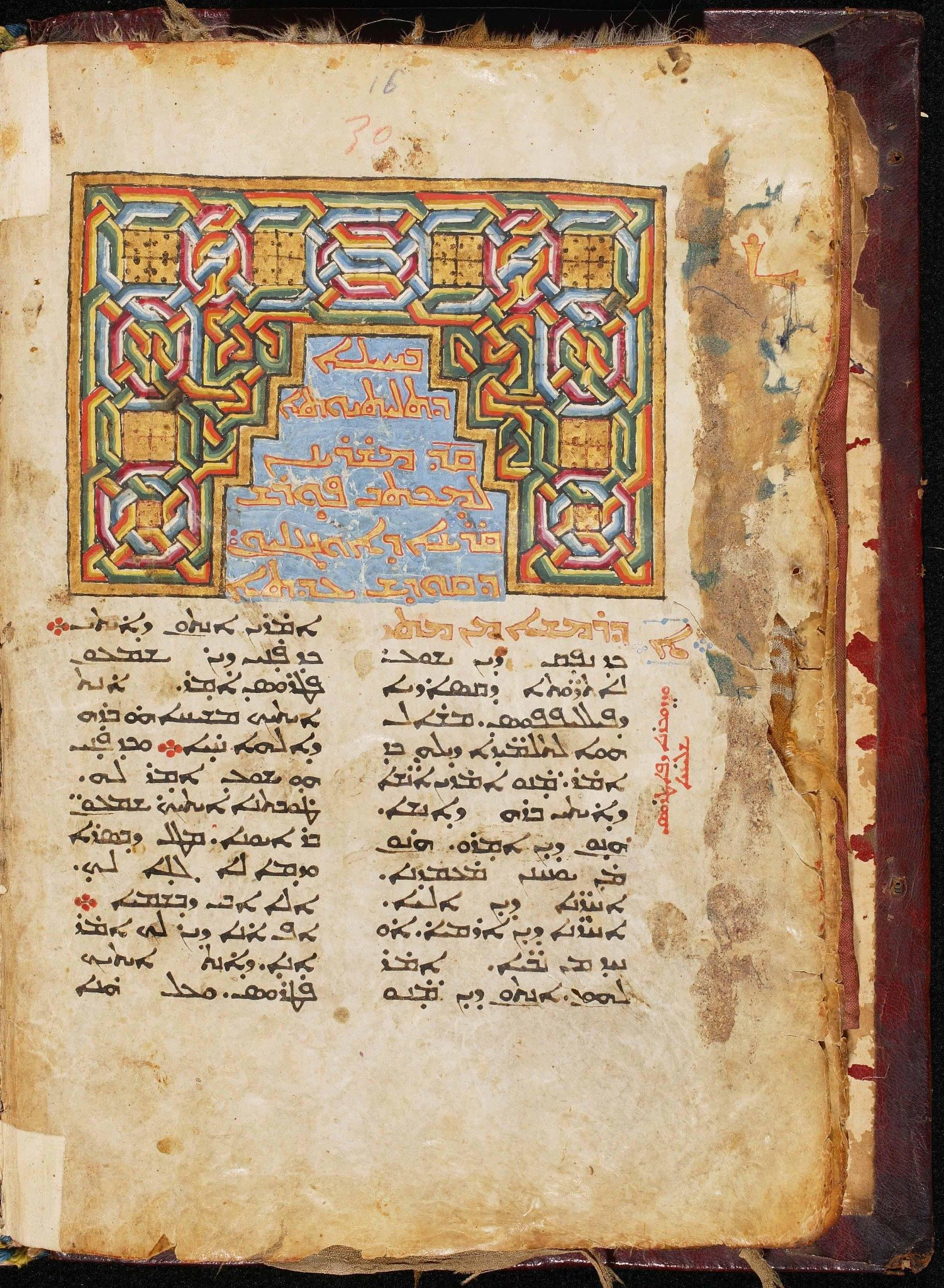
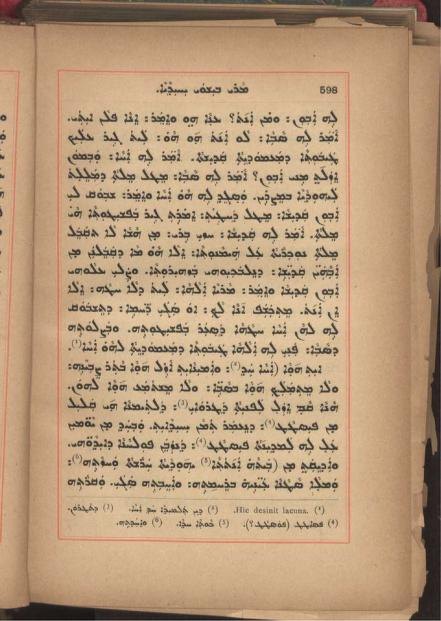
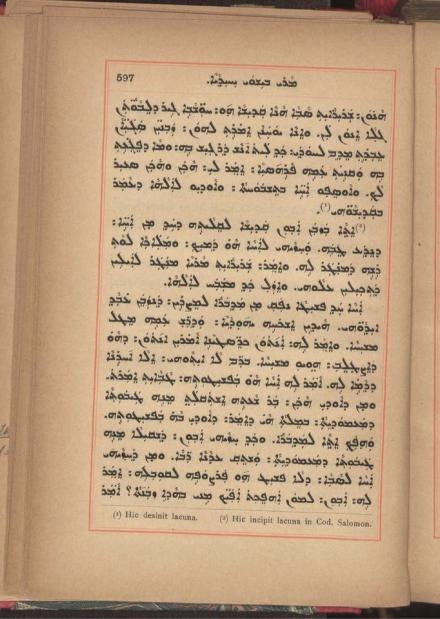
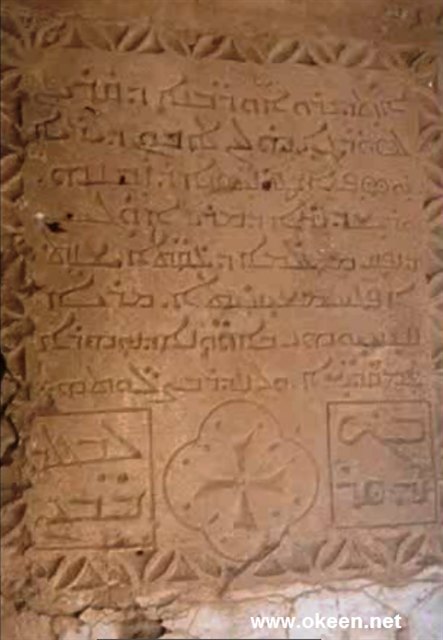
Note on image rights: images of manuscripts and their sources require confirmation of the rights to republish them before they are placed on a public website, especially images from HMML and from modern collections. Supplying an image for review here is not a general licence to republish it. Use the original you are authorised to use on the site.
15. What still needs to be proved?
Update of 11 November 2026: the conversion of the Coptic year 1054 to 1338 CE was settled in Dr Davis's second letter. The following questions remain, concerning the oldest origin of the text, the scribe, the place, and the relationships between the witnesses.
A proposed programme of investigation
First: adopt Dr Davis's correction of 10 November 2026 confirming 1338 CE, and review the final text of the entry when volume five is published. Second: follow the publication of volume five (DS Arabic Mayāmir 96), respecting the rule that images of the collection are not shared without the monastery's permission. Third: collate the text of Anba Matthaeus's book with the Syriac edition at the introduction and the names of the disciples, acknowledging that the end of the Life of Mar Okeen is lost from the Arabic manuscript. Fourth: study the relationship of the endowment statement to the hand of Yuhanna al-Fayyumi and the circumstances in which the collection reached the monastery. [23]
It is proposed to create a permanent research record for each witness, with its shelf number, permanent link, status of consultation, page or folio, and date of verification.
New tasks after the second edition
Collate the colophon of Add MS 14653 as described by Berti with the colophon of Arabic Manuscript 297, if one exists; locate the Mar Okeen passages in E28; extract the original pages from Addai Scher's 1906 book; and search for archived copies of okeen.net to verify the date of Arabic electronic publication.
Following up the archive documentation
Examine the domain's creation date if possible, search for copies of the Manuscript 297 page from before 2012, save images of the digital evidence, and then compare later Arabic texts with the archived content, documenting the date of each copy; the old library files that can be recovered should also be retrieved and their rights checked.