Coptic–Syriac Relations Through the Ages
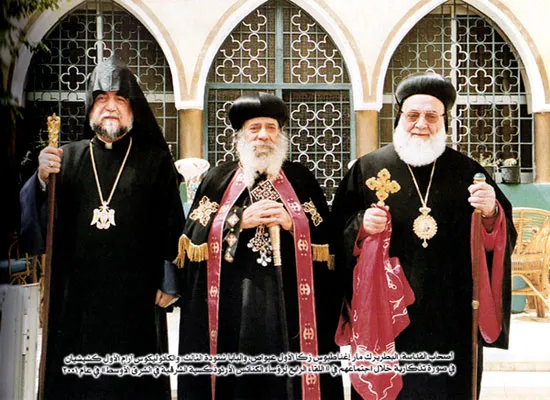
This page summarizes, in English, a long Arabic article first published in the encyclopedia “Min Turath al-Qibt” (From the Heritage of the Copts), vol. 5. The complete Arabic article, with its 125 footnotes, is on Okeen.net.
Introduction
The Syrians (Syriacs) were among the first peoples to believe in Christ; the disciples were first called Christians at Antioch. Like the Copts, they rejected the decisions of the Council of Chalcedon, and the two Churches have been bound by strong ties ever since, above all through monasticism. Each has influenced the other’s liturgy and rites: scholars have noted the close similarity of their baptismal rites; the Copts adopted from the Syriacs, in the nineteenth century, the “Syrian Fraction” prayer of the Liturgy (“Thus truly the Word of God suffered in the flesh”); the Coptic Church honors many Syriac saints in the Commemoration and the Synaxarium, among them Saint Severus of Antioch, Saint Ephrem, Saint Isaac and Saint Barsoum; and many Syriac words entered Coptic Church usage, such as toubay (blessed), nayyah (gave rest, departed) and mimar (homily).
The Christian (Byzantine) Era
Monasticism
Monasticism, which began in Upper Egypt with Saint Antony the Great, was the first meeting point of the two Churches. The Coptic monk Awgin (Saint Okeen) went out with seventy Coptic monks to Mesopotamia, settled south of Nisibis and then on Mount Izla, where his cave became the Monastery of Mar Awgin and some 350 monks gathered around him; he and his disciples preached the Gospel in the surrounding villages. (The article notes that the Greek name is rendered Eukin in Coptic, which is why the Copts know him as Saint Evkin.) Monasteries named after Coptic saints grew up around the mountain, among them the monastery of Mar Malki of Clysma and his brother Mar Elisha, nephews of Saint Awgin; the monastery of Mar Jacob the Egyptian Recluse; a monastery of Saint Moses the Black; and the “Dome of the Egyptians” at the Monastery of Mar Gabriel.
The lives of the Coptic desert fathers were translated into Syriac, and many Syriac monks traveled to the Egyptian deserts, most famously Saint Ephrem the Syrian, who, tradition says, visited Saint Anba Pishoi, each miraculously understanding the other’s language. Syriac monks kept coming to Egypt until at least the nineteenth century, as the El-Sourian Monastery itself bears witness.
After Chalcedon
After the Council of Chalcedon (451) the Churches of Alexandria and Antioch, sharing the same persecutions, drew closer. Pope Theodosius of Alexandria took part in the consecration of Saint Jacob Baradaeus (c. 543), after whom the Chalcedonians called both Copts and Syriacs “Jacobites.”
- Egypt hosts a Patriarch of Antioch: Saint Severus of Antioch fled to Egypt in 519 and lived there about twenty years. The Coptic Church loved him, gave him three feasts in its Synaxarium and names him in the Commemoration of the Liturgy immediately after Saint Mark. He departed at Sakha; his body was moved to the Monastery of al-Zujaj near Alexandria and later to El-Sourian.
- A beautiful tradition: on their accession, the patriarchs of the two sees exchanged letters confessing the one Orthodox faith, collected in a manuscript of 1078 called The Confession of the Fathers.
- Patriarchs from each other’s Church: Paul II “the Black,” of Coptic origin, became Patriarch of Antioch (550–575), and Damian I, of Syrian origin, became Pope of Alexandria (563–598). In 593 the abbot of the Monastery of Mar Awgin on Mount Izla was a Coptic monk, Abraham the Copt.
- Reconciliation: after a 28-year estrangement, Patriarch Athanasius I of Antioch visited Pope Anastasius of Alexandria at the Monastery of al-Zujaj in 615, and they spent a month together studying the Scriptures. In this period Thomas of Harkel completed in Alexandria his careful revision of the Syriac New Testament (the Harklean version).
The Arab Era (640–1805)
- Under the Umayyads: Theodore, a Coptic monk from Upper Egypt, became Patriarch of Antioch in 649. Simon I, a Syrian raised at the Monastery of al-Zujaj, became the 42nd Pope of Alexandria (692–700). After his departure, the Syrian archon Athanasius of Edessa helped care for the Church in Egypt during the vacancy of the see.
- The El-Sourian Monastery: historians differ on its founding as the monastery of the Syrians in Scetis: some credit three monks from Tikrit (between 819 and 836), others the purchase of the monastery by the Tikriti merchant Marutha son of Habib, and others link it to the visits of Patriarch Dionysius of Tel Mahre.
- Under the Abbasids: Patriarch Dionysius of Tel Mahre visited Egypt in 827, received at Tinnis by Pope Jacob with a great crowd, and interceded with the governor to lower the taxes of the people of Tinnis; he came again in 832 with the Caliph al-Ma’mun during the Bashmurite revolt.
- Under the Fatimids: two Syrians became Popes of Alexandria, among them the merchant Abraham ibn Zaraa (the 62nd Pope). In 1088 the historian Mawhub ibn Mansur recorded the Syriac monks living at El-Sourian. A dispute arose in the time of Pope Christodoulos over the bread of the Eucharist.
- Under the Ayyubids and Mamluks: Copts migrated in numbers to Syria, especially during the famine under Pope Cyril III (1235–1242), and a Coptic community with its own church formed in Damascus; some Coptic patriarchs later came from this community. There were times of tension as well as visits, and a Coptic monastery existed in Syria. A Patriarch of Antioch was consecrated in Egypt, the holy Myron was consecrated in Egypt for the Syriacs in 1430, and Syriac priests took part in the consecration of the Myron in 1461.
- Under the Ottomans: visits by Syriac bishops and monks to Egypt continued, until the Syriac monastic presence at El-Sourian came to an end.
The Modern Era (from 1805 to about 2005)
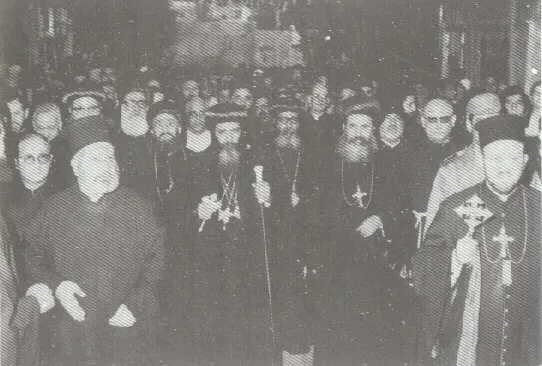
- Patriarchal visits resumed: in January 1959; at the Addis Ababa Conference of the Oriental Orthodox Churches (1965); at the celebrations of Saint Mark in Egypt; and when the Patriarch of Antioch took part in the enthronement of the Coptic Pope.
- Pope Shenouda III visited the Syriac Patriarchate in Damascus in 1972, and the two Churches shared in each other’s celebrations and sorrows, including the celebrations of Saint Athanasius in Egypt.
- Syriac monks studied at the Coptic Clerical College in Cairo, and Coptic monks and teachers taught at the Syriac seminary; a Coptic priest was ordained at the Patriarchate of Antioch, and the Antiochian Church honored Coptic archons.
- The patriarchs of the Oriental Orthodox Churches met in Cairo; Coptic nuns served at the Syriac Patriarchate in Damascus (1998).
- Shared pastoral care: in Iraq, Brazil, England and elsewhere in the diaspora, Coptic and Syriac faithful have received the sacraments from each other’s clergy and prayed in each other’s churches when their own were not available.
Read also: The Monastery of Mar Awgin · The Monastery of the Virgin Mary (El-Sourian)
Sources
- Originally published in the encyclopedia "Min Turath al-Qibt" (From the Heritage of the Copts), vol. 5