Mar Mikha of Nuhadra
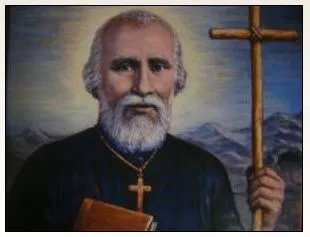
Mar Mikha of Nuhadra was born in the region of Nuhadra in the first decade of the fourth century, around 309 AD. He was called “of Nuhadra” after that region, which includes the plains of Nineveh, lying between the Mesopotamian desert and the mountains of northern Iraq. His parents were Magians, and his forefathers were among the chiefs of the Magi and companions of the king. His father was called Kurshah. His parents became Christians and received baptism at the hands of Saint Mar Awgin, the father of monks in the East.
From childhood Mikha was drawn to the Church, so his parents placed him in the church to live there and receive a Christian upbringing. He learned the language and the rite and completed the Book of Psalms. The church was far from his parents’ home, so they visited him once a year, bringing him money, clothing, food and drink. But as soon as he had said goodbye to his parents, he would distribute all these good things to the poor and needy, keeping only a little for himself, a sign of the seeds of goodness that lay within him from his earliest years. He remained there until he grew strong, drank deeply of knowledge from the divine books, and became fit to enter the monastic life, which was his hope and desire.
He went to join the monastic life on Mount Izla. Mar Awgin received him into his monastery and clothed him in the monastic schema. Mar Mikha spent about twenty years in the monastery, a model of the devout, pious monk, obedient to the rules of the monastery, following the instructions of his superiors and fulfilling every duty the monastic life required of him. Mar Awgin loved him greatly, treated him like a son, and gave him a special place among his brother monks. He took him to Nisibis to visit its bishop, Mar Jacob of Nisibis, and also took him to Mount Judi for the consecration of the monastery that Mar Jacob of Nisibis had built there, known as the Monastery of the Ark (Qaybutha), at the place where Noah’s Ark came to rest.
In 361 Julian persecuted the Church, and all the monks fled the monastery except Mar Awgin and ten of the brother monks. During that time Mar Mikha lived as a solitary in a small hut, a life of austerity and hardship, practicing every bodily discipline to train his body and put to death its desires, spending his nights in prayer, meditation and reading the Holy Scriptures. Several times he faced temptations of the flesh and of money, and he resisted and overcame them with courage and determination, holding fast to fasting, prayer and worship night and day. The Lord rewarded him with a divine power to heal the sick of their bodily and spiritual ailments. His fame spread throughout those regions, and people came to him and he healed them by the power of God.
Mar Mikha conceived the idea of visiting the Holy Land, to receive blessing and pray beside the Holy Sepulchre. He set out, and when he reached Damascus he visited the temple that holds the relics of Saint John the Baptist. From there he set off for Jerusalem with two men who were going there. On the way bandits attacked them and wanted to rob them, and when they found nothing on them, they took them for spies and shut them in a cave. That night a wonder took place: after the bandits had left, a terrible pain came upon them that kept them from sleeping and left them awake all night, tossing on their beds in agony. When they looked for the cause, they found nothing but their injustice toward those innocent travelers imprisoned in the cave, and understood that this pain was a punishment because of them.
As soon as morning came they hurried to the cave, released them, and begged their pardon and forgiveness. Mar Mikha made them promise to repent and stop their evil deeds. The bandits accepted, repented and were sorry, and the pain left them and they were healed at once. Then Mar Mikha and his two companions continued on to Jerusalem until they reached it and entered.
Mar Mikha entered the Holy City full of longing to visit all the places once trodden by the Savior. He wanted to enter every place Jesus had entered, to listen for His voice ringing out in the Temple as He taught and rebuked the scribes and Pharisees for their deeds, and to walk the streets where the Savior had walked carrying His Cross on His shoulders. At last he reached the Holy Sepulchre. He entered with reverence and awe, and bowed down in prayer to the One who was buried there and rose from it, asking Him to help him follow in His footsteps and walk in His way.
In Jerusalem he met Flavian, Metropolitan of Antioch, who welcomed him and rejoiced to meet him. In those days people came from Tarsus asking Flavian to ordain a bishop for them, and he advised them to ask for Mar Mikha, and they agreed. Flavian urged him to accept their request, because he had been chosen by God to shepherd His sheep, and he agreed.
On the Feast of Pentecost Flavian laid his hand on Mikha and ordained him Metropolitan of Tarsus. A few days later Mikha disappeared; the people of Tarsus looked for him but could not find him. He had left by night for Mount Sinai, moved by his humility and his longing for the ascetic and solitary life. When he arrived there, he visited the place where the revelation came down to Moses the Prophet.
From there he went to the desert of Scetis, where a great number of brother monks lived lives of renunciation, withdrawn from the world, worshipping God in silence and stillness. After he had learned about their life and way of living, he went deep into the desert, where he found a hut and made it his dwelling. He lived in it for twenty years, completely cut off from the world, worshipping his Lord and speaking with Him night and day in prayer and fasting. All those years he lived on the plants of the desert, which became his daily food. One night, while he was absorbed in fervent prayer to his Creator, it was revealed to him that he should return to the East and build a monastery at Alqosh. He rose at once and set out on the journey back, passing through Jerusalem again on the way to receive its blessing.
It seems that Alqosh was Christian in the fourth century and had a church where prayers and services were held by priests, deacons and the community of believers. The story of Mar Mikha supports this, for it says that priests, deacons and a great crowd of the townspeople came out to receive him. Mar Mikha’s arrival in Alqosh was sudden and unexpected; the people of Alqosh had never imagined that a man like Mar Mikha would visit their village and stay there. So their going out to meet him and their warm and honorable welcome came by divine inspiration and heavenly providence.
He arrived at a time when an epidemic had spread there and was killing the children in great numbers. Mar Mikha asked the people to repent, fast and pray, and they responded with fervor and longing, praying and entreating God together with him. God heard their supplication through his intercession: the epidemic left the village and its children stopped dying. Joy and gladness filled its homes, and its people were certain that this newcomer was a messenger sent by God to their village, who had come to save them from disease, call them to repentance, and guide them to a new life, a life of grace, virtue and the love of God. This made a deep impression on the people of Alqosh, who found in him an intercessor and guide. They loved him, embraced him, honored him and treated him with great respect.
When Mar Mikha came to Alqosh, he carried nothing but the book of the Gospel. His fame spread to the surrounding places, and people brought him their sick and suffering, and he healed them all. They offered him gold and silver, and he accepted it from them. The people of Alqosh felt that Mar Mikha needed a house of his own in which to live and receive visitors, and they saw his desire to teach and form the young men and children. So they built a monastery and a school on the southeast side of the village, where he could live and carry out the mission for which he had come to Alqosh. When the building was complete, Mar Mikha invited the bishop of Ma’altha and his clergy to open and consecrate the monastery, since Alqosh at that time belonged to the diocese of Nuhadra. Mar Mikha gathered into his school all the children and students from Alqosh and its surroundings and housed them in his monastery to live together. This required large sums of money, so he used the gold and silver the faithful had given him to buy farmland east and west of Alqosh. To this day there is farmland in the plain of Alqosh called “the lands of the priests,” and west of Alqosh, in the village of Bandwaya, there is a mill called “the Mill of Mar Mikha,” which was probably among the properties of the Monastery of Mar Mikha. He used the income from these properties to support his school and the needs of his students. Mar Mikha prophesied the coming of Rabban Hormizd to Alqosh, saying: “God is about to send you a great eagle, who will rise in rank above the angels and nest beside you on this mountain, and will beget spiritual offspring. Whoever calls upon his name, the Lord will drive every pain from him, and he will have power over the bitterness and poison of deadly creeping things. This mountain will be called the heavenly Jerusalem. Go out to meet him with joy.”
Mar Mikha lived for fifteen years in a small hut inside the monastery built at Alqosh, practicing fasting, prayer and the Christian virtues and directing his school, whose fame spread far and wide. One day after the afternoon prayer he gathered the priests, deacons and students of his school, preached to them, prayed over them and gave them his last counsel, then bade them farewell and blessed them. He turned his gaze toward Alqosh and blessed it, saying, “May no enemy rule over you.” He closed his eyes and gave up his spirit to his Creator and Maker. It is said that Mar Mikha dug his grave with his own hands in the very hut where he lived, and he was buried in that same place, and prayers were offered for his soul. He departed on 1 November 429, at nearly one hundred and twenty years of age.
The Church of the East commemorates Mar Mikha of Nuhadra on 1 November.
Read also: The Church of Mar Mikha in Alqosh
Sources
- Wikipedia (Arabic): Mar Mikha of Nuhadra