The City of Nisibis
The historic city of Nisibis, lying dormant today beneath modern Nusaybin, is like a great volcano that once raged and fell silent in later days; or rather, it was a bright star high in the sky, seen and written about by every people. It always occupied the great powers that dominated much of the world: the Persians, the Romans, the Byzantines and later the Arabs.
When I began gathering information about the history of Nisibis, I tried to recall what I had read in history books over the years, and searched through some of them (the Chronicle of Michael the Great and the History of the Church of the East). Nisibis has the lion’s share, always present on the political, economic and religious stage.
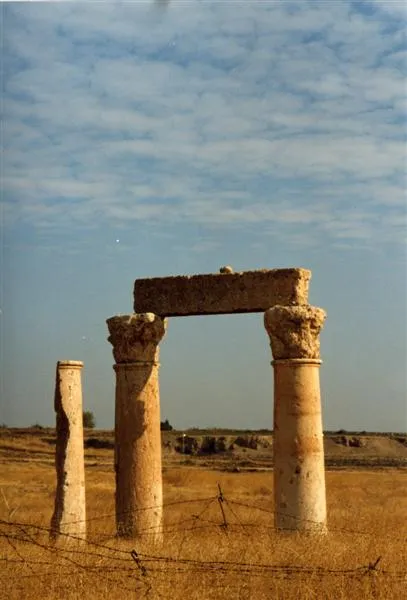
The surviving monument of Nisibis, as you see in the picture, has behind it the barbed wire that marks the border between Syria and Turkey. This wire is old; today there is a modern fence with watchtowers on the Syrian side. The photograph was taken from Nusaybin looking toward Qamishli. About 100 meters from this monument is “al-Badan,” which some say is among the historic remains of Nisibis.
History of the City
Nisibis is very ancient, and its name appears in the Holy Scriptures. Its location is first mentioned on a cuneiform tablet kept in the British Museum in London, in connection with wars fought in 612 BC between the Assyrians on one side and the Medes on the other.
The Greeks called it Antiochia Mygdonia, and perhaps the Syrians themselves used this name, but its own Syriac name was “Soba” or “Nisibin,” derived from nsaw, meaning “planting,” because of its many orchards and gardens. Saint Ephrem of Nisibis said that it is the “Akkad” mentioned in the Book of Genesis, and its founding is attributed to Nimrod the mighty hunter.
Like Edessa, it was a caravan station, a prominent commercial center and a fertile agricultural region. Nisibis was the capital of a native kingdom until Seleucus I Nicator renewed it and named it Antiochia Mygdonia. The Romans fought over it until it came into their hands in 297, and Diocletian (284–305) made it the fortified stronghold of the East and the seat of the commander of Mesopotamia (Dux Mesopotamiae).
Nisibis lies at the foot of Mount Izla, where the plains meet the Taurus Mountains on the southern side of present-day Turkey. As the poet Abu Nuwas once said:
Nisibin was good to me one day, and I was glad of it; would that my lot in this world were Nisibin.
The city lay on an important road linking it to Edessa, Adiabene (Erbil) and Armenia to the east; to Sinjar and Hatra to the southeast; to Mesene, the Gulf and India to the south; to Manbij and Syria to the west; and to Palmyra. All this shows the commercial and economic importance of Nisibis.
The lands of Nisibis are watered by the Jaghjagh River, which descends from two springs in the mountain of Tur Abdin in Turkey, passes through Nusaybin and then Qamishli, and flows on until it joins the Khabur at Hasakah; it is the main tributary of the Khabur, 100 km long in Syria. In Roman times the Jaghjagh was known as the Mygdonius, and the Arabs called it al-Hirmas, the river beside which Saint Okeen and his disciples settled, as his Life relates. A dam built on it in Turkey has greatly reduced its waters.
Nisibis Passes to the Persians
The successive wars between the Persians and the Romans left many cities of the Euphrates region in ruins. When the Romans organized themselves under a new banner, Christianity, it made an impression on Shapur, the Persian emperor. During his negotiations with the Roman emperor he said to him, “You have ruined our land and laid it waste; either give us the value of what you destroyed, or compensate us with Nisibis.” The Persians received Nisibis and accepted it as compensation for the losses the Romans had inflicted. They would not allow any inhabitant loyal to the Romans to remain in Nisibis, but drove them out in order to make it the empire’s first line of defense, and settled about twelve thousand households there.
Before the Persians took over, many inhabitants of Nisibis left for Amida and Edessa, among them Ephrem, who would long for Nisibis and send it aid during the famine of 372. His school moved with him, with most of its teachers; he reorganized it and remained its director, and it became very famous, known in history as “the School of the Persians” (because it was originally the School of Nisibis, which the Persians had taken).
The last ten years of Ephrem’s life, spent in Edessa in asceticism, teaching and writing, were calm and peaceful. He completed his collections of hymns and his commentaries on the Bible and refuted the heresies of his day. Out of humility he declined ordination to the priesthood, remaining a deacon all his life.
Christianity in Nisibis
Christianity in Nisibis is ancient; the most important early witness is the inscription of Abercius, written around 200. The story of Christianity there is linked with Saint Thomas the Apostle, Addai, Aggai and the apostle Mar Mari.
Elijah bar Shinaya affirms in his Chronography that Mar Jacob built the great church of Nisibis, which took seven years to build, and that he founded its school and saved the city from the Persian siege of 338. From the early centuries Nisibis became a great metropolitan see of the Church of the East, and remained so until late times.
It included the region of Beth Arbaye, reaching to the gates of Mosul, together with Armenia. Among the bishoprics belonging to this see, three lay in the territory under the Mongols: Sinjar, Beth Zabdai (Jazirat ibn Umar), and Balad with Jilsuna; they are mentioned until 1318. A list dating to 1607 counts seven monasteries in the Jazira region: those of John of Nahla, Phinehas, Aha, Jonah, Isaac, John of Kamul and John the Egyptian.
Nisibis has been a border city in the past as in the present: in ancient times it marked the frontier between the Persian and Roman empires, and today it stands on the Turkish–Syrian border. Historians link the division of the Syriac language into Eastern and Western to the lands lying east and west of Nisibis.
Nisibis in the Islamic Period
The Muslims took Nisibis in the seventh century, when Iyad ibn Ghanm entered it in 640. The political and military balance of Nisibis and the Jazira changed after the armies of the Muslim Arabs arrived and became a third power alongside the Persian and Byzantine empires; they appointed their governors over the Jazira. Because of its distance from the center of the caliphate, Nisibis became a target for those who sought states independent of it; revolts multiplied there and it became a refuge for opponents of the central caliphate, so that its government changed repeatedly.
Yet the people of the Jazira remained Christian, though the jizya tax was imposed on them, which burdened their leaders; so they negotiated with the Caliph Umar ibn al-Khattab after he threatened them with exile and captivity.
It is recorded that a governor of Nisibis named Isaac Babak, appointed by Zengi, feared that Zengi might take revenge on him for some reason, and ordered the demolition of all the fortresses in his province that could not withstand Zengi’s advance. He destroyed the fortress of Hur Abra, Tell Basma known as Thomas, the fortress of Tella, and the castle beside the Monastery of Mar Hananya known as the Castle of the Woman. When they tried to demolish the wall of Nisibis they could not shake the ancient structure, so strong was it, and they abandoned the citadel.
The frontier between the Byzantines and the Sassanians was a line running from Mayferqat (Martyropolis, “the city of the martyrs”) to Dara, Nisibis and Circesium, and from there straight to the Gulf of Aqaba.
The city of Qamishli, built opposite it on the Syrian side in the second decade of the twentieth century to receive those displaced from Nisibis and its surrounding villages who fled Ottoman oppression, is known among the Syriacs as “New Nisibis.”
Sources
- The Chronicle of Michael the Great (Michael the Syrian)
- History of the Church of the East
- Elijah of Nisibis (Bar Shinaya), Chronography