Mar Ishaya of Aleppo
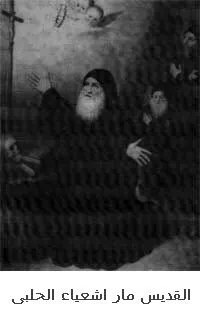
This saint is among the disciples of Mar Awgin who became most widely known, especially in Bazabde.
He was the son of Somax, governor of Aleppo. From his youth he was raised in the love of virtue and faith, and he learned the principles of Christianity and theology. His father wanted him to marry, but he refused, expressing his desire to turn away from the temptations of this passing world. His father insisted, however, and betrothed him to Hanna, the daughter of his minister Nu’man, and held a wedding feast for him that lasted seven days and nights. After the crowning (wedding rite), Ishaya went into his bride’s room, determined to persuade her of his intention. He began to prepare her for what he wished to say: “Do you remember the day we met at the well, and you called me ‘my brother’ and I called you ‘my sister’?” Hanna said, “Yes, I remember.” Ishaya said, “Is there anything more beautiful than to be joined in the brotherhood of the Lord Jesus Christ? You will remain my betrothed in the Lord Jesus Christ.” Then he revealed to her his spiritual intentions and his desire for the ascetic life and worship, and his bride accepted and was persuaded. He said to her, “Give me my ring and take yours.” They bade each other farewell. Before they parted, Hanna said to him, “I beg you, my brother Ishaya, when your Lord reveals to you the end of my life, do not hesitate to come.” He promised her he would, and asked her not to tell his parents until morning. They parted in peace, she saying to him, “The Lord be with you, my brother Ishaya.”
He walked on foot until he reached the Euphrates by night and slept. In the morning he rose and began to walk on the water, by the power of God, and reached Tell Kawkab near the Syrian city of Hasakah. He spent the night on the banks of the Khabur River, and in the morning continued until he reached the city of Nisibis, where he stayed four days. Then he went to the village of Inhil and remained there four years, worshipping in a cell he built for himself. Then he went to Saint Mar Awgin on Mount Izla, and a sincere friendship grew between them. He stayed with him two years, then went to the village of al-Wardiya, which was ruled by Kush, the Persian king. The king had no children, so his sister gave him one of her sons, named Mahnush, whom the king raised and loved dearly. But the boy died of a grave illness, and the king grieved deeply; he threw the crown from his head and sat on the ground lamenting his fate. One of the Christians there wanted to comfort him and said, “Do not grieve, my lord. Here in your city is Saint Mar Ishaya, who has the power to bring your son back to life.” The king mocked him, saying, “How can he raise a dead man who has been buried under the earth for two days?” The man said, “Try, my lord.”
So the king sent for the saint. When Mar Ishaya came, carrying his cross, he greeted the king and said, “What do you wish, O king?” He answered, “My only son died two days ago, and I have been told that you are able to bring him back to life.” Ishaya said, “I will ask my God to restore his life.” Then Ishaya went with the king to the tomb, and the saint began to pray with reverence: “O God, You are able to do all things; You raised Lazarus. Show Your wonders today, that these peoples may believe in You.” As soon as the saint finished his prayer, he saw the stones roll away from the door of the tomb, and the dead Mahnush rose from his grave. The king was overcome with amazement and wept for joy, crying, “I believe in your God, Ishaya!” The saint then asked him to remove the centers of idol worship, and the king did so. He built a church in the saint’s name, and the king and his subjects believed and were baptized, three thousand six hundred people in all. The king asked his son how he had spent those two days while he was dead. The boy said, “Father, I found all the idol worshippers in a deep, dark abyss. But I found the believers among the angels, praising God. And I found this righteous man Ishaya clothed in great light; he came to the heavenly King and asked for me earnestly, and God was pleased and returned me to life.”
After that the saint traveled to Bazabde (Azakh), accompanied by a virtuous monk named Shabo. As he was praying near a spring there, the funeral of the son of the governor of Bazabde, the Roman king Muriq, passed by. Ishaya said to the mourners, “God is able to bring him back to life.” When the king heard this, he summoned the saint and said to him, “Can anyone raise the dead?” The saint answered, “God is able to do all things.” The king asked him to bring his son back to life. The saint prayed with reverence, and as soon as he placed the cross on the dead body, the boy rose at once and began to speak. Everyone was astonished and marveled, and they cried out, “There is no God but the God of Ishaya!” The king and his court rejoiced. Then Ishaya asked him to demolish all the idol temples in the city. The governor did as he wished and built a church in the saint’s name on the ruins of the idol temples. Then the king and Mar Ishaya went to another place in Bazabde, where the saint struck the ground with his staff and water sprang up. Crowds came to receive the sacrament of holy baptism from those pure waters, the governor of the city first among them. He remained in Bazabde (Azakh) for ten years, then left for the village of Inhil, where he stayed about six years and baptized 630 souls, all of whom came to the Christian faith. Then he went to the monastery of Saint Mar Awgin. There he dug a well on the bank of the River Hirmas (Jaghjagh), which became a spring of healing for the sick and the gravely ill. He stayed there nine months in works of righteousness, holiness and great austerity, and afterward moved to the top of the mountain and shut himself in a small cell he built for himself. One day a man tormented by the devil was brought there. He drank from that well and was healed, and those present heard a voice saying, “Ah, Ishaya, you have come to drive me out of every place!” The man began to pray and earnestly begged the saint to accept him as his disciple. The saint agreed and began to train him in works of righteousness and holiness until he trusted him, and entrusted him with the care of the cell.
The saint then set out to visit the Holy Land in Palestine. When he reached the Euphrates, he did not wish to cross it on foot as he had done before, lest he be carried away by pride and fall into sin. Instead he wanted to board the boat that people were getting into. When the boatman was about to collect the fares from the passengers, he was angered at the sight of the saint in his shabby, torn clothes, seized him by the hand and threw him into the river. But the saint immediately stood up and began to cross the river walking on his feet. A violent wind struck the boat and nearly sank it. The passengers were terrified and cried and shouted, and great was their astonishment as they watched the saint walking on the surface of the water. They called to him for help, crying, “O saint of God, save us! The boatman has fallen into the river and we are about to drown!” The saint asked God, “O Lord, do not destroy these people because of me.” The wind ceased and the boat steadied. Moments later angels carried him away, and he found himself at the gates of the city of Aleppo. At first he did not want to enter, fearing that his father the king would see him in those torn clothes. When he reached the spring where he had first met his betrothed, he remembered her, and it was revealed to him that she was about to depart this life. So he went to the convent where she lived, for she too had left the world after him and become a nun. She had kept her chastity and purity, practicing works of holiness and austerity until her time drew near. In the convent the saint knelt before the Gospel, asking God to let him see his betrothed so that they might bid each other a last farewell. It was revealed to Saint Hanna that a man in torn clothes was kneeling before the Gospel, and she wanted to see him to bid him farewell. The abbess came and told Ishaya, “Hanna is calling you.” The saint came and saw his betrothed Hanna, who called to him, “Come in peace, my beloved, my pure and chaste betrothed.” Then they bade each other farewell, and choirs of angels filled the convent with rays of light. The saint looked at Hanna, sobbing, his tears falling like pouring rain. When the abbess recognized him, she fell at his feet asking him to pray for her, and the saint asked her not to spread news of his presence until he had left the city. The news of Saint Hanna’s death spread, and crowds gathered for the funeral of her pure body, led by Somax, the governor of the city, and his court. Saint Ishaya walked with the funeral procession, shedding tears in burning grief, which drew everyone’s attention. Yet no one recognized him, so weak, thin and changed in complexion had he become. After the burial of the saint, the governor gave a great feast, attended by two thousand of the poor and needy, Saint Ishaya among them. That night the saint took advantage of the darkness and left the city for the Holy Land.
As for the governor, Ishaya’s father, he set aside much gold and distributed it to the poor for the repose of Hanna’s soul. He asked that a large sum be given to the man who had walked in the funeral procession in shabby clothes, but no one knew who he was. When he asked the abbess about him, she wept before him, saying, “That man was Ishaya your son. He was weeping for Hanna his betrothed. He came to the convent after the Holy Spirit carried him here, to bid her a last farewell.” Then she told him that Ishaya had gone on pilgrimage to the Holy Land. When the king heard this, he fainted from the shock. Then he sent his troops to search for his son and bring him back, and they spread out along every road searching for him for three days. After that Ishaya appeared to his father in a dream and said to him, “Father, do not tire yourself searching for me, for God has ordained that you and I shall not meet in this world. But because of your kindness to the poor, God will reward you in the world to come. After two years you and I will meet, not in this world, but in the presence of the Lord Christ. And now, father, let your troops return to their posts, and you continue doing good.” The king awoke from his dream in fear and returned his troops to their positions.
After leaving Aleppo, Ishaya was carried by the Holy Spirit to the Holy Land. When he had fulfilled his devotions there, he wished to return to his cell, and the Holy Spirit carried him back. He came to the River Hirmas and found his disciple, from whom he had cast out the unclean spirit, at prayer. Each of them built himself a cell, and he visited Saint Mar Awgin a second time. The saint departed in the middle of October at the age of ninety-one, and the Church celebrates his feast.
Sources
- The Life of Mar Ishaya of Aleppo, from the Syriac Orthodox tradition