Our Mother Saint Mary: An Encyclopedia
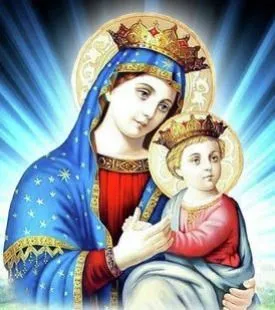
Our Mother the Holy Virgin
There is no woman of whom the prophets prophesied and with whom Scripture is concerned as with the Virgin Mary: many symbols of her in the Old Testament, and her life, her hymn of praise and the miracles in the New. How many glorifications and meditations on the Virgin appear in the writings of the Fathers, and how glorious are the titles the Church gives her, drawn from the spirit of Scripture.
She is the mother of us all, the lady of us all, the pride of our race, the queen standing at the right hand of the King, the ever-virgin, the pure, full of grace, Saint Mary, the mighty, helping and merciful mother, the Mother of the Light, the mother of mercy and salvation, the true vine.
The Church raises her above the rank of the archangels, so that we say of her in our praises and hymns: “You are higher, O Mary, than the cherubim; you are more exalted, O Mary, than the seraphim.”
Mary was raised in the Temple and lived a life of prayer and contemplation from her childhood; she was the holy vessel the Lord chose to dwell in. Long generations awaited the birth of this Virgin, so that in her the fullness of time might come (Galatians 4:4). She took away the reproach of Eve and restored the good name of woman after the Fall. She is the Theotokos, the Mother of God, ever-virgin.
She is the Virgin who came to our land during the childhood of Christ and stayed in our country for years, sanctifying and blessing it during that time. She is the Virgin who appeared at Zeitoun in 1968 and drew the hearts of the multitudes by her light, her appearing and her visitation of us. She is the Virgin who works miracles in many places where we celebrate her, and the stories of her miracles are beyond counting.
The Virgin is no stranger to us; she is woven deeply into the feelings of the Copts, passing from doctrine into personal experience and affection. What a great honor for our country and our Church that the Virgin visited it in the past and appeared on its domes for long years. There has been no woman in Christianity whom people have loved as they love the Virgin Mary.
In Egypt most churches celebrate her feast. In the rites there are so many praises, hymns, glorifications, psalis and doxologies dedicated to her, especially in the month of Koiak, and among our Catholic brothers she has a month called the Marian month.
Among the monasteries of Egypt, the Baramus Monastery, the El-Sourian Monastery and the Muharraq Monastery bear her name, and there is a convent in her name at Harat Zuwayla in Cairo; and how many monasteries and schools bear her name in the churches of the West.
The Oldest Churches in Her Name
The oldest church built in the name of the Virgin in the apostolic age is the church of Philippi, and the oldest church built in her name in Egypt was in the time of Pope Theonas, the 16th Patriarch, in 274. Among her most famous churches is the church of the Muharraq Monastery, consecrated in the time of Pope Theophilus, the 23rd Pope, at the beginning of the fifth century, as well as the churches built at the places she visited in Egypt. There are also two churches in Europe named after the Virgin of Zeitoun, one in France and the other in Vienna.
The Greatness of the Virgin
The greatness of the Virgin was affirmed by the holy Ecumenical Council of Ephesus, held in 431 in the presence of 200 bishops from around the world, which composed the introduction to the Creed: “We magnify you, O Mother of the true Light, and we glorify you, O saint and Mother of God, for you have brought forth unto us the Savior of the world. He came and saved our souls.” On what foundations did the Ecumenical Council compose this introduction? This is what we will now explain:
- The Virgin is the blessed saint whose blessedness continues through all generations, as in her hymn: “For behold, henceforth all generations will call me blessed” (Luke 1:48).
- The Church calls the Virgin a queen, as Psalm 45 says of her: “At Your right hand stands the queen.” So many artists, when they paint the Virgin, place a crown on her head and show her at the right hand of the Lord Christ.
- Reverence for the Virgin appears in the angel Gabriel’s greeting: “Rejoice, highly favored one, the Lord is with you; blessed are you among women” (Luke 1:28), that is, with a special blessing, to which Saint Elizabeth also bore witness when she cried out with a loud voice and said to her, “Blessed are you among women, and blessed is the fruit of your womb!” (Luke 1:42).
- Before the Virgin’s greatness, Saint Elizabeth became small in her own eyes and said with a sense of unworthiness, though she knew that her own son would be great in the sight of the Lord and would come in the spirit and power of Elijah (Luke 1:15, 17): “But why is this granted to me, that the mother of my Lord should come to me?” (Luke 1:43).
Perhaps one of the clearest proofs of the Virgin’s greatness and her standing before the Lord is that as soon as her greeting reached Elizabeth, Elizabeth was filled with the Holy Spirit, and her unborn child leaped for joy in her womb. As the divine word says: “And it happened, when Elizabeth heard the greeting of Mary, that the babe leaped in her womb; and Elizabeth was filled with the Holy Spirit” (Luke 1:41).
It is truly an astonishing greatness that her greeting alone filled Elizabeth with the Holy Spirit! Which of the saints ever caused another to be filled with the Holy Spirit by a greeting? Yet Elizabeth bears witness: “For indeed, as soon as the voice of your greeting sounded in my ears, the babe leaped in my womb for joy.” Elizabeth was filled with the Holy Spirit through Mary’s greeting, and received the gift of prophecy and insight, so that she knew this was the mother of her Lord, and that she “believed, for there will be a fulfillment of those things which were told her from the Lord.” She also knew that the child’s leaping was for joy, joy, of course, because of the Blessed One in the Virgin’s womb: “Blessed is the fruit of your womb” (Luke 1:41–45).
The Virgin’s greatness shines in the Lord’s choosing her from among all the women of the world: the one human being for whom the divine plan waited thousands of years, until it found her and saw her worthy of this great honor, which the angel Gabriel explained: “The Holy Spirit will come upon you, and the power of the Highest will overshadow you; therefore, also, that Holy One who is to be born will be called the Son of God” (Luke 1:35).
In her greatness the Virgin surpasses all women, as the divine word says: “Many daughters have done well, but you excel them all” (Proverbs 31:29). Perhaps from this text the Church’s praise was taken: “Many women have received honors, but none of them received as you have.”
This holy Virgin was in God’s mind and in His plan from the beginning. In the salvation promised to our first parents, He said that “the Seed of the woman shall bruise the serpent’s head” (Genesis 3:15). This woman is the Virgin, and her Seed is Christ, who crushed the serpent’s head on the Cross.
A Life Surrounded by Miracles
The miracles of the Virgin’s life begin before her birth and continue after her departure. Among them:
- She was conceived miraculously of barren parents, announced by an angel.
- The miracle of her betrothal, by which God chose the one who would take her and care for her.
- The miracle of her conceiving Christ as a virgin, with her virginity remaining after the birth.
- The miracle of her visit to Elizabeth, who heard her greeting, so that the babe leaped for joy in her womb and she was filled with the Holy Spirit.
- Countless miracles during her visit to the land of Egypt, among them the falling of the idols (Isaiah 19:1).
- The first miracle the Lord worked, at Cana of Galilee, was at her request.
- The miracle of the loosing of the iron chains and the rescue of Matthias the Apostle was through her.
- The miracle of Christ receiving her soul at the hour of her departure.
- The miracle of the Lord striking the Jews when they tried to attack her body after her departure.
- The miracle of the assumption of her body into heaven.
- The miracles worked through her intercession everywhere, about which books have been written.
- Her apparitions in many places, especially her wondrous apparition at our church in Zeitoun and in Papadoplo.
The miracles still continue everywhere, and will continue as a witness to the honor of this saint.
The Fast of the Virgin
From the first of Mesori (7 August) the Church keeps the Fast of the Virgin. The people care for this fast greatly and keep it with strict asceticism; some add days to it, out of their great love for the Virgin.
- The Fast of the Virgin is a time of spiritual revival in most churches, with a spiritual program of daily sermons and, in some churches, daily Liturgies, even in churches not named after the Virgin.
- A great feast of the Virgin is held at her ancient church in Mostorod, and feasts of other saints also fall in these days: the feast of Saint George at the Monastery of Mit Damsis in the second half of August, the feast of Saint Abba Macarius the Great, and the feast of Saint George at his monastery in Rizeiqat.
- During the Fast of the Virgin we also celebrate the feasts of famous women saints, such as Saint Paesia (2 Mesori, 8 August), Saint Julitta (6 Mesori, 12 August) and Saint Marina (15 Mesori, 21 August); and during the fast we also celebrate the glorious feast of the Transfiguration on 13 Mesori (19 August). In the same month (7 Mesori, 13 August) is the commemoration of the angel Gabriel’s announcement to Saint Joachim of the birth of the Virgin Mary.
- The Fast of the Virgin is not the only occasion on which the Church celebrates the Virgin; there is above all the month of Koiak, full of praises, glorifications and psalis for the holy Virgin Mary.
- The Copts in Egypt, especially women, care for the Fast of the Virgin beyond description. Many keep it with “water and salt,” that is, without oil; many add a third week as a vow; and some vow to keep it abstaining from food until the stars appear in the sky.
What is the secret of this devotion? First, the Copts’ love for the Virgin, who visited their country and blessed it, leaving traces of her presence in many places where churches have been built. Second, the many miracles in Egypt through the intercession of the Virgin, which have led many to rejoice in building churches in her name. Perhaps the Virgin’s apparition at her church in Zeitoun, and the miracles that accompanied it, increased the Copts’ attachment to the Virgin and to the fast that bears her name.
The Feasts of the Virgin
Every saint has one feast in the Church, the day of their departure or martyrdom, and perhaps another for the finding of their relics, a miracle in their name, or the building of a church dedicated to them. But the holy Virgin has very many feasts, among them:
- The Annunciation of her birth: 7 Mesori, when the angel of the Lord announced her birth to her father Joachim; he and her mother Anna rejoiced and vowed her to the Lord.
- The Nativity of the Virgin: celebrated by the Church on 1 Pashons.
- Her entrance into the Temple: celebrated on 3 Koiak, the day she entered the Temple to worship in the court set apart for virgins.
- Her coming to Egypt: with the Lord Christ and Joseph the carpenter, celebrated on 24 Pashons.
- The Departure (Dormition) of the Virgin: 21 Tobi. On this day the Church also remembers the miracles that took place, when the apostolic fathers were around her, except Saint Thomas, who was then preaching in India.
- The monthly feast of the Virgin: the 21st of every Coptic month, in memory of her departure on 21 Tobi.
- The Assumption of her body into heaven: celebrated on 16 Mesori (22 August), preceded by the Fast of the Virgin (15 days).
- The feast of her miracle (the loosing of the iron): 21 Paone, when we remember her miracle of freeing Saint Matthias the Apostle and those with him by loosing the iron chains with which they were bound; we also celebrate the building of the first church in her name at Philippi.
- The feast of her apparition at Zeitoun: on the domes of the Church of the Virgin, which began on 2 April 1968 and continued for years; it corresponds approximately to 24 Paremhat.
All these feasts have their own hymns and doxologies in the rite of the Church, filled with the prophecies and Old Testament symbols concerning her. In addition, throughout the month of Koiak (from about 10 December to 7 January) we celebrate with praises all devoted to the honor of the Virgin.
The Virgin Mary in the Doctrine of the Church
The Coptic Orthodox Church honors the Virgin with the honor due to her, without exaggeration and without diminishing her:
- In the Church’s belief she is the Mother of God (Theotokos), not merely “the mother of Jesus,” as the Nestorians claimed; Saint Cyril of Alexandria fought them, and the holy Ecumenical Council of Ephesus anathematized them.
- The Church believes that the Holy Spirit sanctified the Virgin’s womb at the conception of Christ, as the angel said to her: “The Holy Spirit will come upon you, and the power of the Highest will overshadow you; therefore, also, that Holy One who is to be born will be called the Son of God.” The Holy Spirit’s sanctification of her womb means that the One born of her was conceived without the stain of original sin; the Virgin herself, however, was conceived by her mother like all people, and so the Virgin said in her hymn, “And my spirit has rejoiced in God my Savior” (Luke 1:47). The Church therefore does not accept that the Virgin was conceived without the stain of original sin, as our Catholic brothers believe.
- The Church believes in the intercession of the Virgin, and places her intercession before that of the angels and archangels, for she is the Mother of God and the queen standing at the right hand of the King.
- Scripture calls the Virgin full of grace. Unfortunately the Beirut translation, diminishing the Virgin, renders this title as “highly favored,” and all people are favored, but the Virgin is full of grace. Yet grace does not mean infallibility.
- The Church believes in the perpetual virginity of the Virgin; only our Protestant brothers depart from this, teaching that the Virgin had children after Christ.
- The Church believes in the Assumption of the Virgin’s body into heaven, and celebrates it on 16 Mesori.
The Titles and Symbols of the Virgin
A. Titles Expressing Her Greatness and Her Closeness to God
- The Queen, standing at the right hand of the King, as the Psalm says: “At Your right hand stands the queen” (Psalm 45:9). So she is always painted in her icon at the right hand of the Lord Christ, and in the Divine Liturgy we call her “our lady and queen of us all.”
- Our mother the holy Virgin, as the Lord Christ said from the Cross to His disciple Saint John the Beloved: “Behold your mother!” (John 19:27).
- Jacob’s ladder, the ladder that reached from earth to heaven (Genesis 28:12), a symbol of the Virgin, who by giving birth to Christ brought the dwellers of earth to heaven.
- The Bride, for she is the true bride of the Lord of Glory, in whom the Lord’s word in the Psalm was fulfilled: “Listen, O daughter, consider and incline your ear; forget your own people also, and your father’s house; so the King will greatly desire your beauty; because He is your Lord, worship Him” (Psalm 45:10–11). So she was called the Beloved of Solomon, that is, the Virgin of the Song. In the same Psalm it is said of her: “The royal daughter is all glorious within; her clothing is woven with gold.”
- The beautiful dove, recalling the dove that brought our father Noah an olive branch, a sign of peace, bearing the good news of salvation from the waters of the Flood (Genesis 8:11). With this title the priest censes her icon as he comes out of the sanctuary, saying: “Hail to you, O Virgin Mary, the beautiful dove.” The Virgin is likened to the dove in her simplicity, her purity and the work of the Holy Spirit in her, and to the dove that carried the good news of salvation after the Flood, because she carried the good news of salvation in Christ.
- The cloud, for her exaltation, and because prophecy likened her so in her coming to Egypt: “The burden against Egypt. Behold, the Lord rides on a swift cloud, and will come into Egypt; the idols of Egypt will totter at His presence, and the heart of Egypt will melt in its midst” (Isaiah 19:1). The word “cloud” signifies her exaltation, and the Lord who comes on the clouds (Matthew 26:64).
B. Titles and Symbols Expressing Her Motherhood of the Lord Christ
- Theotokos, that is, Mother of God, the title given her by the holy Ecumenical Council of Ephesus in 431, and the title Saint Cyril the Great upheld against Nestorius. With the title “the mother of my Lord” Saint Elizabeth addressed her (Luke 1:43).
- The golden censer: we call her ti shouri, “the censer” in Coptic, and sometimes “the censer of Aaron.” The coal inside it signifies the humanity of Christ and the fire His divinity, as Scripture says: “Our God is a consuming fire” (Hebrews 12:29). So the censer signifies the Virgin’s womb, in which the divinity was united with the humanity; that the censer is of gold shows the Virgin’s greatness and purity, and so in her hymns we call her “the golden censer.”
- The second heaven: for as heaven is the dwelling of God, so the Virgin Mary was the dwelling of God during the holy conception.
- The City of God, in whom the prophecy of the Psalm is fulfilled: “Glorious things are spoken of you, O city of God!” (Psalm 87:3). She is also called “the city of the great King,” and certain prophecies spoken of Jerusalem or Zion are fulfilled in her, as the Psalm also says: “And of Zion it will be said, ‘This one and that one were born in her; and the Most High Himself shall establish her’” (Psalm 87:5).
- The vine that bore the cluster of life, that is, the Lord Christ. With this title the Church asks her intercession in the prayer of the Third Hour: “O Theotokos, you are the true vine that bore the cluster of life.”
- Through this motherhood she has other titles too: Mother of the true Light, since the Lord Christ is called the true Light that gives light to every man (John 1:9), and likewise the golden lampstand, because she carries the Light; Mother of the Holy One, since the angel, announcing the birth of Christ, said to her, “That Holy One who is to be born will be called the Son of God” (Luke 1:35); and Mother of the Savior, for the Lord Christ is the Savior of the world, and He was named Jesus because He saves His people from their sins (Matthew 1:21).
- The bush that Moses the prophet saw (Exodus 3:2): we say in the praise, “The bush that Moses saw in the wilderness is a figure of the blessed Mother of the Light; she carried the fire of the divinity nine months in her womb, and it did not harm her.” The Lord is called a consuming fire (Hebrews 12:29), symbolized by the fire burning within the bush, and the bush symbolizes the holy Virgin.
- The Ark of the Covenant, made of acacia wood that does not rot, overlaid with gold inside and out (Exodus 25:10–22), a symbol of the Virgin’s purity and greatness. It was also a symbol through what it held within, things that signify the Lord Christ: the golden pot holding the manna, Aaron’s rod that budded, and the tablets of the Law (Hebrews 9:4), a symbol of the incarnate Word of God.
- The pot of manna, for the manna was a symbol of the Lord Christ as the living bread that came down from heaven, of which whoever eats will live, the bread of life (John 6:32, 48, 49). Since the Lord Christ is likened to the manna, the Virgin may be likened to the pot of manna that held this heavenly bread within it.
- Aaron’s rod that budded, that is, blossomed and bore buds of life by a miracle (Numbers 17:6–8), though a rod has no life in it to bring forth flowers and fruit. This signifies the virginity of the Virgin, who could not have brought forth offspring, yet gave birth by a miracle. This description appears in the Sunday Psalis.
- The Tabernacle of Meeting (the Tent of Moses): the Lord dwelt in the Tabernacle, and the Lord dwelt in the Virgin; in both God showed His love for His people. So we say in the Psalmody: “The tabernacle that Moses made on Mount Sinai, they likened you to it, O Virgin Mary… in which God is.”
- The gate facing east, which Ezekiel the prophet saw, of which the Lord said: “This gate shall be shut; it shall not be opened, and no man shall enter by it, because the Lord God of Israel has entered by it; therefore it shall be shut” (Ezekiel 44:1–2). At this eastern gate the prophet saw the glory of the Lord filling the house (Ezekiel 43:2–5). This signifies the virginity of the Virgin, who was of the lands of the East, and how this virginity remained sealed.
- The gate of life, the gate of salvation: the Book of Ezekiel speaks of the Virgin as the gate through which the Lord of Glory entered and went out (Ezekiel 44:2). If the Lord is life, she is the gate of life; the Lord said, “I am the resurrection and the life” (John 11:25), so the Virgin is the gate of life, the gate from which the Lord came forth, giving life to all who believe in Him. And if the Lord is salvation, having come as salvation to the world to save what was lost (Luke 19:10), then the Virgin is the gate of salvation. It is not strange that the Virgin is called a gate, for our father Jacob said of Bethel, “How awesome is this place! This is none other than the house of God, and this is the gate of heaven!” (Genesis 28:17).
- The Holy of Holies: for the high priest entered it once a year to make atonement for the whole people, and the Lord of Glory dwelt within the Virgin Mary once for the redemption of the whole world.
The Virtues of the Virgin
A Life of Humility
Humility was an essential condition for her of whom the Lord of Glory would be born. He had to be born of a humble woman who could bear the glory of the divine Incarnation from her: the glory of the Spirit dwelling in her, the glory of the Lord’s birth from her, the glory of all the generations calling her blessed, and Elizabeth’s humbling herself before her, saying, “Why is this granted to me, that the mother of my Lord should come to me?” (Luke 1:48, 43); and who could bear all the appearances of angels, the worship of the Magi before her Son, the many miracles her Son worked in the land of Egypt, and the very light of this Son in her arms. So the fullness of time (Galatians 4:4) waited for this woman of whom the Son of God would be born. Her humility appeared in her life, as we shall see:
- The angel announced to her that she would become the mother of the Lord, but she said, “Behold the maidservant of the Lord!” (Luke 1:38), that is, His servant and handmaid. The great glory given her did not diminish her humility at all; rather, because of this humility God gave her this glory, for “He has regarded the lowly state of His maidservant… He who is mighty has done great things for me” (Luke 1:48–49).
- The Virgin’s humility appeared also in her going to Elizabeth to serve her during her pregnancy. As soon as she heard that Elizabeth was with child, in her sixth month, she traveled to her on a hard journey through the hill country and stayed with her three months until her time came to give birth (Luke 1:39–56). She did this while carrying the Lord of Glory.
- Part of her humility was that she did not speak of the glories of the divine Incarnation.
A Life of Surrender
She lived as a pure saint in the Temple; then the time came when she was told to leave the Temple, and she did not protest or object, as many women do who, when church canons keep them from entering the church at certain times, complain and argue much in protest. She was living unmarried, and they told her to live under the care of a man, as the customs of her day required. She did not protest, and accepted living under a man’s care as she had accepted leaving the Temple.
She lived a life of surrender, not objecting, resisting or protesting, but yielding to God’s will quietly and without argument. She had resolved to live in virginity and had never once thought of becoming a mother. When God willed that she become a mother by the Holy Spirit coming upon her (Luke 1:35), she did not argue, but answered with her immortal words: “Behold the maidservant of the Lord! Let it be to me according to your word.” So God gave her motherhood and preserved her virginity too, and she became a mother, something she had never imagined. Through surrender she became the Mother of the Lord, indeed the greatest of mothers.
She was told to flee to Egypt, and she fled; she was told to return from Egypt, and she returned; she was told to move her home from Bethlehem and live in Nazareth, and she moved and lived there. She was a quiet woman who lived a life of surrender without argument, and so the Mighty One did great things for her, for He regarded the lowliness of His handmaid.
A Life of Endurance
She was orphaned of both her parents at the age of eight and bore the life of an orphan. She lived in the Temple as a child and endured the life of solitude there; she left the Temple to live under the care of a carpenter and endured a life of poverty. When she gave birth to her only Son there was no room for her in the house, so she laid Him in a manger (Luke 2:7), and she endured that too. She bore responsibility while still young, and bore the glory that surrounded her without being troubled by thoughts of greatness.
She could not declare that she had given birth as a virgin, so she kept silent and endured it. She endured the hard journey to Egypt and back, and endured being driven from town to town there because the idols fell before Christ (Isaiah 19:1). She endured exile and poverty, and endured that “a sword will pierce through your own soul” (Luke 2:35) because of the persecutions and insults her Son suffered, and finally the sufferings and shame of the Cross.
Yet the Virgin did not merely endure passively; she lived in joy in the Lord, as she said in her hymn: “My spirit has rejoiced in God my Savior” (Luke 1:47).
Faith Without Complaint
In all she endured she never complained: when Herod threatened her Son with death, in the flight to Egypt, and in the persecution He suffered from the Jews, she never said, “Where is the promise that He will sit on the throne of His father David and reign… and of His kingdom there will be no end?” (Luke 1:32–33). Rather, she was patient, as Elizabeth said of her: “Blessed is she who believed, for there will be a fulfillment of those things which were told her from the Lord” (Luke 1:45).
She believed that she would give birth as a virgin, and it was fulfilled. She believed that the Holy One born of her was the Son of God (Luke 1:35), though He was born in a manger, and what she believed was confirmed by the visions she saw, the angels, and the miracles He worked. She believed all this despite all the persecutions He suffered. She believed in Him as He hung on the Cross, and she saw Him after He rose from the dead (Matthew 28).
Silence, Prayer and Contemplation
It was God’s plan that the Virgin be orphaned and live in the Temple, and in the Temple she learned the life of solitude and silence and to give herself to prayer and contemplation. Having lost the love and tenderness of her parents, she gave herself to the love of God alone. She devoted herself to prayer, praise and the reading of Holy Scripture, memorizing many of its verses and the Psalms. Her hymn in the house of Elizabeth is clear evidence of this, for most of its words are taken from the Psalms and the verses of Scripture.
Silence became one of her marks. Though at the events of the Nativity she saw wondrous things, perhaps beyond what a young girl could bear, and was surrounded by miracles and by the words of angels, shepherds and Magi, she did not speak boastfully of the glories of the Nativity, but “kept all these things and pondered them in her heart” (Luke 2:19).
The silent, contemplative Virgin is a lesson for us: may we, like her, contemplate much and speak little. Yet I see that when the time came for her to speak, she became a source of Church tradition for some of the accounts the apostles and evangelists learned from her: of the miracles and events during the flight into Egypt, and of the child Christ’s conversation among the teachers in the Temple (Luke 2:46–47).
The Lord chose this poor orphan girl to be the greatest woman who ever lived, and in her virtues she possessed something greater than riches. Among her virtues also are her personal holiness, her chastity and virginity, her spiritual knowledge, her service to others, and her spiritual motherhood of the apostolic fathers. Time would fail us to speak of all her virtues.
The Blessing of the Virgin
How many blessings have been given to the Virgin, in the hymns of the Church and the Tasbeha, in the Theotokias and praises, in the doxologies on each of her feast days, in the Koiak Psalmody and in the hymns of the Church. The Church remembers her in the Commemoration of the Saints before the archangels, and so in all its intercessions. In blessing the Virgin the Church fulfills the prophecy she spoke in her hymn: “For behold, henceforth all generations will call me blessed” (Luke 1:48).
The Church offers her incense and offers her greeting; how many praises begin with the words “Hail to Mary” (Sheri ne Maria), or with “Rejoice, O Mary,” or the praise in which David the prophet plays the ten strings of his harp, naming a blessing of her with each string.
We remember her in the Agpeya, in the Liturgy and in all the books of the Church: in the Synaxarium, the Difnar, the Katameros, the Psalmody, and the books of responses and hymns. In the prayers of the Agpeya we remember her in the third section of every hour of the day, asking her intercession, and we remember her in the Creed, saying in its introduction: “We magnify you, O Mother of the true Light, and we glorify you, O saint and Mother of God.”
We remember her at the beginning and end of the prayer of blessing: we begin the blessing with “the prayers, supplications and entreaties which the holy and pure Mother of God, Saint Mary, offers for us at all times,” and after naming the angels, apostles, prophets, martyrs and all the saints, we end the blessing with her, saying: “and the blessing of the Virgin, first and last.”
The Icon of the Virgin
There is a difference between pictures for contemplation and an icon for the liturgy:
- In icons she must appear with Christ, as the Mother of God, at His right hand, as the Psalm says: “At Your right hand stands the queen” (Psalm 45:9).
- Because she is a queen, there is a crown on her head, as on Christ’s.
- As a saint, a halo of light surrounds her head, for the Lord said, “You are the light of the world” (Matthew 5:14).
- Because she is the second heaven, stars, angels and clouds surround her.
Intercede for us, O holy Virgin, that the Lord may embrace us with His mercy.