His Holiness Pope Shenouda III
The 117th Patriarch of the See of St. Mark · 1971–2012
His Holiness Pope Shenouda III is one of the most prominent fathers of the Coptic Orthodox Church in its modern history. He brought together the monastic life, theological teaching and patriarchal pastoral care, and his service reached churches and monasteries in Egypt and across the diaspora. He left a large legacy of books, sermons and spiritual poetry, and he remained bound to the Monastery of the Virgin Mary of the Syrians (El-Sourian), where he became a monk, even after he took his seat on the throne of St. Mark.
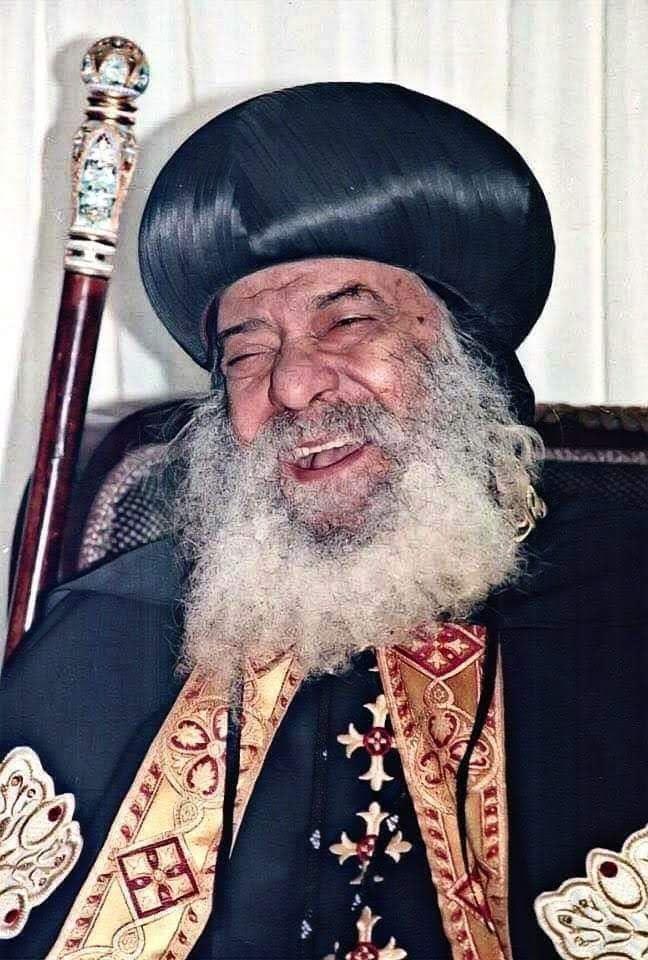
| Key facts | |
|---|---|
| Name before monasticism | Nazir Gayed Rafael |
| Born | Friday, 3 August 1923 |
| Birthplace | The village of Salam, Assiut Governorate, Egypt |
| University | BA in History, Faculty of Arts, 1947 |
| Monastic vows | 18 July 1954, El-Sourian Monastery |
| Monastic name | Fr. Antonious El-Souriany |
| Ordained priest | 31 August 1958 |
| Consecrated bishop | 30 September 1962, as Anba Shenouda |
| Altar lot | Sunday, 31 October 1971 |
| Enthroned as Patriarch | Sunday, 14 November 1971 |
| Departed | Saturday, 17 March 2012 |
| Resting place | The Monastery of St. Bishoy, Wadi El-Natrun |
1. Birth, upbringing and formation
Nazir Gayed Rafael was born on Friday, 3 August 1923, in the village of Salam in Assiut Governorate, Upper Egypt. The El-Sourian Monastery’s account of his life says that at about six years old he moved to Damanhour to live with his elder brother, and he completed parts of his schooling in several cities, among them Damanhour, Alexandria, Assiut and Benha. He then settled in Cairo and finished his secondary education at the Al-Iman Secondary School in Gezirat Badran, Shubra.
From his youth he showed a clear love of reading, literature and history. He loved poetry, its meanings and its rhythm, and poetry became a lasting part of his literary and spiritual work. He was also bound early on to the Church and to Sunday School service, which helped shape his spiritual and teaching character before he began the monastic life.
He enrolled in the Faculty of Arts at Fouad I University, later Cairo University, and graduated from the Department of History in 1947. In the same year he completed his studies at the Reserve Officers’ College. His interest in history reached from ancient Egyptian civilisation to Islamic and modern history, and this showed later in his lectures and writings.
2. Sunday School service and theological studies
Nazir Gayed began serving in Sunday School in 1939 at the Church of the Virgin Mary in Mahmasha, Cairo, and in 1946 served at the Church of St. Antony in Shikolani, Shubra. He was known for his love of teaching and orderly explanation and his care for young people, alongside his work in writing, visiting and spiritual service.
He entered the Coptic Theological Seminary in 1946 and completed his studies there in the late 1940s. The published historical records of the Coptic Church date his graduation to 1949, while one El-Sourian account gives 1950. After his studies he devoted himself to teaching at the Seminary and to church work; the monastery’s account says that Archdeacon Habib Girgis encouraged him to teach there.
In October 1949 he became editor-in-chief of Sunday School magazine, a responsibility he held until his monastic vows in 1954. In 1952 he was chosen as chairman of the board of the Sunday School House, then stepped down to devote himself to service and teaching. He also taught at the monks’ school in Helwan in 1953. In these years he combined broad academic knowledge, specialised theological study and direct experience of teaching in the Church.
3. Monastic life at the Monastery of the Virgin Mary of the Syrians
Nazir Gayed had loved monasticism since his youth, and he visited the El-Sourian Monastery in Wadi El-Natrun before joining it. According to the historical account handed down by the monastery’s fathers, he came to the monastery on 15 July 1954 wishing to consecrate his life to God; he was known to Anba Theophilus, the bishop of the monastery, and to a number of the monks. On Sunday, 18 July 1954, he became a monk under the name Fr. Antonious El-Souriany.
His life in the monastery was not limited to prayer and solitude. He took charge of the monastery library, arranging and cataloguing its books; the library held references and manuscripts of great value for the history of the Church. The monastery’s account also says that he took part in spiritual guidance, receiving visitors, serving the retreat house and overseeing some works and buildings. His bond with the library, with reading and with writing became one of the marks of his monastic years.
The monastery’s account relates that the German scholar Otto Meinardus, writing about El-Sourian in the early 1960s, praised the learning and education of Fr. Antonious El-Souriany. This appreciation is given here as testimony reported in the monastery’s book, without quoting the foreign edition word for word.
Fr. Antonious also turned to the solitary life in the desert. The Church’s official biography dates the start of his seclusion to February 1956, while the monastery’s account says he spent a period in 1957 in a cave west of the monastery, and around 1960 lived for a time in a cave overlooking the area of Al-Bahr Al-Farigh, about twelve kilometres south of the monastery. These retreats gave him long periods for prayer, contemplation, reading and writing.
On Sunday, 31 August 1958, he was ordained a priest by Anba Theophilus, bishop of the monastery, and served as a priest and spiritual guide alongside his ascetic life. The monastery’s account says that he later declined promotion to the rank of hegumen, out of humility and a wish to keep to the simple monastic life.
In June 1959 Pope Kyrillos VI chose him as his secretary. As he took on wider responsibilities, his bond with El-Sourian stayed strong: he kept returning there for quiet and prayer, and his relationship with the monastery’s fathers and his solitary cell remained part of his spiritual life.
4. Bishop of Education and religious institutes
On Sunday, 30 September 1962, the monk-priest Antonious El-Souriany was consecrated General Bishop for Christian Education, Church Education and Religious Institutes, under the name Anba Shenouda, in the time of Pope Kyrillos VI. On the same day Anba Samuel was consecrated Bishop of Public Services. The creation of these two specialised bishoprics was an important step in organising the service of the Church.
Anba Shenouda gave great care to the Theological Seminary and to religious education, and he expanded the lectures and spiritual meetings at the Anba Ruways grounds in Abbasiya. He was known for his clear style and his ability to make theological and spiritual subjects simple, and he took the questions of those present seriously and set aside time to talk with them.
In January 1965 he issued the first number of Al-Keraza magazine under his editorship. At first it was tied to the Seminary and to teaching; during his patriarchate it grew into a wider church magazine and became weekly in October 1974. In 1966 he became a member of the Egyptian Press Syndicate. Despite the burdens of the episcopate, his bond with the monastery where he became a monk never broke.
5. Election and enthronement as Pope of Alexandria
After the departure of Pope Kyrillos VI on 9 March 1971, the process of choosing a new patriarch began. Anba Shenouda was among the candidates, and became one of the three names the election produced on 26 October 1971. On Sunday, 31 October, the altar lot was drawn, and it fell to Anba Shenouda.
On Sunday, 14 November 1971, the prayers and rites of his enthronement were held at St. Mark’s Cathedral in Abbasiya, attended by the fathers of the Church, church delegations, public figures and crowds of the faithful. He took the name Pope Shenouda III, becoming Pope of Alexandria and Patriarch of the See of St. Mark, the 117th in the line of the patriarchs of St. Mark. His patriarchate lasted more than forty years, until his departure in 2012.
6. Teaching and writing during his patriarchate
Teaching remained at the heart of Pope Shenouda III’s service. He kept up his weekly meetings and sermons, above all the Wednesday meeting, which grew into a large gathering of people of all ages and backgrounds. He explained the Holy Scripture, matters of doctrine and the spiritual life, and answered the questions of those present in a direct way that joined teaching with pastoral care.
He wrote a great many books and articles on spirituality, doctrine, interpretation of Scripture, family life, church service and answers to theological questions. Official church references say his works number more than a hundred books, and some were translated into other languages. He also wrote spiritual and patriotic poems; poetry stayed part of him from his youth.
He strengthened the Theological Seminary, opening branches inside and outside Egypt, and founded institutions for theological study and church formation. In 1974 the Institute of Pastoral Care and the Bible Institute were founded. He also cared for Al-Keraza, for publications and for the media, and his years saw cultural centres and Coptic satellite channels that carried the Church’s teaching to wide regions.
7. Monasticism, renewal of monasteries and care for the young
Pope Shenouda III kept a special love for monasticism. He made a point of spending regular time in Wadi El-Natrun, above all at the Monastery of St. Bishoy. He worked to restore ancient monasteries and to encourage monastic life, and his time saw Coptic monasteries founded in the diaspora. The El-Sourian account mentions his care for renewing monastic life at the Monastery of St. Demiana in Barari, the Monastery of St. Pachomius in Edfu, the Monastery of St. George in Rizeiqat and the Monastery of the Virgin Mary in Akhmim, among others.
He did not forget El-Sourian, where his monastic life began: on 18 July 1979 he celebrated the silver jubilee of his monastic vows there and celebrated the Divine Liturgy in the monastery. Memories of his life in its library, its caves and his cell remained among the strongest links between his patriarchal service and his monastic roots.
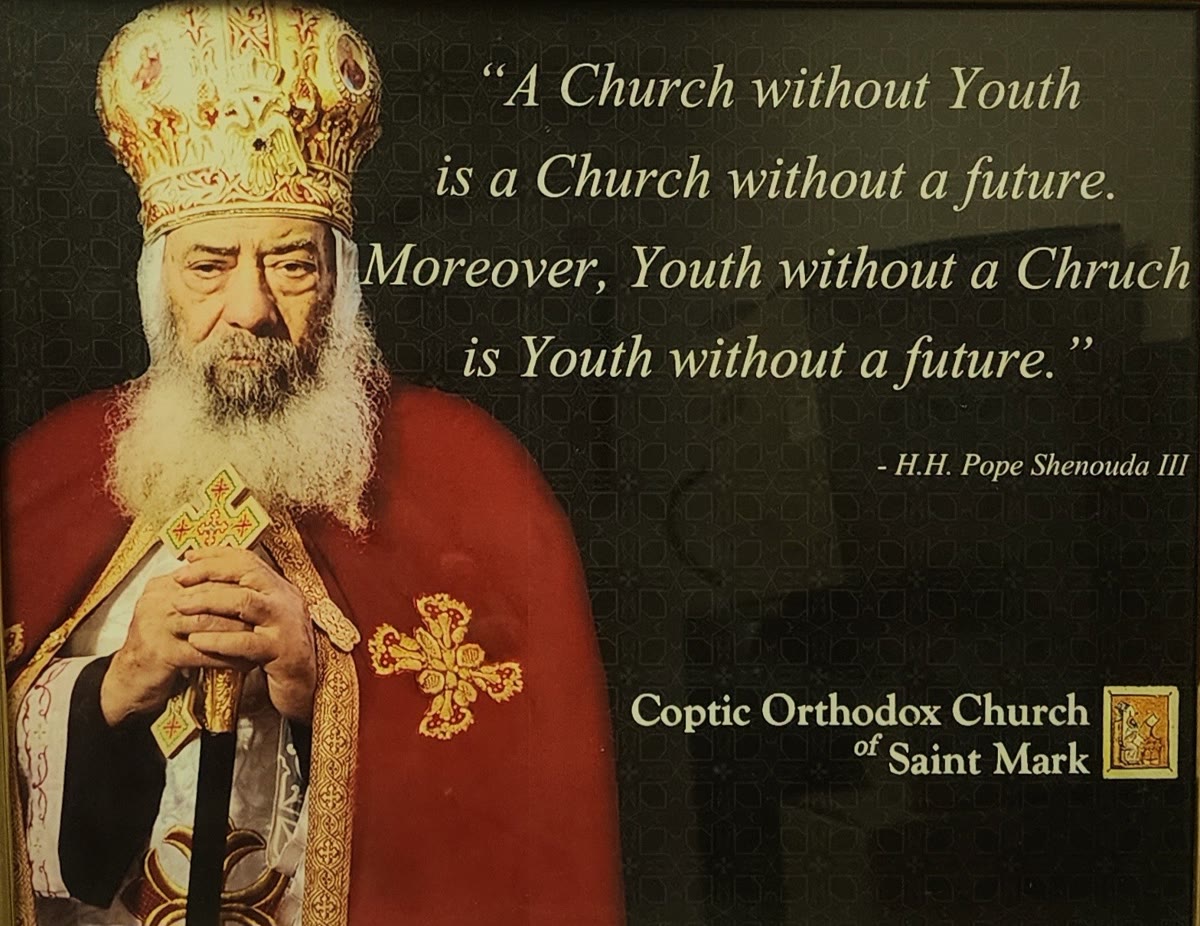
Service to the young was among his chief concerns. On 25 May 1980 he founded the Bishopric of Youth and consecrated Anba Moussa as General Bishop for this service, and youth conferences and spiritual, educational and practical services spread inside and outside Egypt. He also cared for consecrated women; a rule for consecrated women was issued in his time in 1991, and he ordered many sides of church life through rules, among them the rule of the Holy Synod in 1985.
8. The diaspora and service in Africa
The time of Pope Shenouda III saw the Coptic Orthodox Church spread widely outside Egypt, as Coptic communities grew in North America, Europe, Australia and Africa. He sent priests and bishops and founded churches, dioceses, monasteries and centres of service and teaching. He made many pastoral and ecumenical journeys to visit the children of the Church and see to their needs; the Church’s official history records 104 journeys outside Egypt.
He also cared for the African continent: a General Bishopric for African Affairs was founded in 1976, and the Coptic Church’s services spread to a number of African countries. In 1998 he took part in founding the Eritrean Patriarchate by consecrating Abune Philipos as its patriarch, and Abune Antonios was consecrated Patriarch of Eritrea in 2004.
In his time a great number of metropolitans, bishops and priests were ordained; the Church’s official historical records give 117 metropolitans, bishops and chorbishops, and about a thousand priests for Cairo, Alexandria and the diaspora. He also prepared the holy Myron seven times during his patriarchate.
9. Ecumenical relations and dialogue between churches
Pope Shenouda III was one of the leading figures in dialogue between the Christian churches in the second half of the twentieth century. In 1972 he made an ecumenical journey that included meetings with the heads of Orthodox and Oriental churches, and in May 1973 he made a historic visit to the Vatican, where he met Pope Paul VI.
On 10 May 1973 Pope Shenouda III and Pope Paul VI signed a common declaration on faith in Christ, an important step in rapprochement and theological dialogue between the Coptic Orthodox and Catholic Churches. In the same year relics of St. Athanasius the Apostolic were returned to Egypt from Rome. Theological and ecumenical dialogue with other churches continued after that.
In February 1991 he was elected one of the presidents of the World Council of Churches, serving until 1998. In November 1994 he was chosen as a president of the Middle East Council of Churches for the family of Oriental Orthodox Churches, and was re-elected in later terms. He also had a part in efforts for reconciliation and cooperation among the Oriental Orthodox Churches.
10. The trial of September 1981 and the return in 1985
During his patriarchate Pope Shenouda III faced hard political and social challenges, the greatest being the crisis in the time of President Mohamed Anwar El-Sadat. In September 1981 a presidential decree withdrew official recognition of him as patriarch, and he was placed under house arrest at the papal residence in the Monastery of St. Bishoy in Wadi El-Natrun.
This lasted about forty months. During that time he was kept from his usual pastoral work at the papal seat in Cairo and spent his time in the monastery. In January 1985 he returned to his papal seat in the time of President Mohamed Hosni Mubarak and took up his pastoral and teaching work again on a large scale. These events are among the important moments in the history of the relationship between Church and State in modern Egypt.
His later years of service saw changing conditions and social and security challenges that faced the Copts and Egyptian society as a whole. He spoke often of love, peace and belonging to Egypt, while caring for the unity of the Church and the shepherding of its children. In 2011 Egypt went through a great political change, and in February the Standing Committee of the Holy Synod issued a statement on the national events.
11. Departure, funeral and burial
After a long journey of service, monasticism and teaching, His Holiness Pope Shenouda III departed in peace on Saturday, 17 March 2012, at the age of about eighty-eight years and seven months. He had sat on the throne of St. Mark for more than forty years and four months.
The funeral prayers were held on Tuesday, 20 March 2012, at St. Mark’s Cathedral in Abbasiya, attended by great numbers of the faithful and by church and official figures and delegations from Egypt and abroad. His body was then carried to the Monastery of St. Bishoy in Wadi El-Natrun and buried in a shrine prepared for him there, as he had wished.
He was succeeded on the throne of St. Mark by Pope Tawadros II, chosen by altar lot in November 2012. The memory of Pope Shenouda III remains alive in the Church through his recorded sermons, his books, his poems, his teaching institutions, and the churches and monasteries whose service grew in his time.
12. His spiritual and historical legacy
The life of Pope Shenouda III joins several paths into one: the history student who became a teacher of the Church; the monk of El-Sourian who loved the desert and solitude; the Bishop of Education who cared for institutes and servants; and the patriarch who led the Coptic Church in Egypt and in its worldwide growth for more than four decades.
The importance of his life lies in the mark he left on teaching, preaching, writing, monasticism, service to the young and the diaspora, and ecumenical dialogue, together with his experience of complex political and social events. His books and recorded sermons are still read, studied and treasured by generations of Copts and others.
In the history of El-Sourian his name is bound especially to the service of the library and its manuscripts, to his years of solitude in the desert, and to the spiritual bond that lasted between him and the monastery and its fathers until his last days. His life remains an important chapter in the history of the Coptic Orthodox Church in modern times.
Key dates
- 1923: Born in the village of Salam, Assiut Governorate.
- 1939: Begins serving in Sunday School.
- 1947: Graduates in History from Fouad I University and from the Reserve Officers’ College.
- 1949: Devotes himself to teaching at the Seminary and becomes editor of Sunday School magazine.
- 1954: Becomes a monk at El-Sourian as Fr. Antonious El-Souriany.
- 1958: Ordained priest by Anba Theophilus.
- 1962: Consecrated General Bishop for Education as Anba Shenouda.
- 1965: First number of Al-Keraza magazine.
- 1971: Chosen by altar lot and enthroned as Patriarch.
- 1973: Historic visit to the Vatican and signing of the common declaration.
- 1980: Founds the Bishopric of Youth and consecrates Anba Moussa.
- 1981–1985: Held at the Monastery of St. Bishoy, then returns to the papal seat.
- 1991–1998: One of the presidents of the World Council of Churches.
- 2012: Departs on 17 March; buried at the Monastery of St. Bishoy on 20 March.
Historical references
This biography was prepared from the following sources, taking account of the small differences between some accounts:
- The Coptic Orthodox Church, the official biography of Pope Shenouda III, and modern church history.
- Simaan El-Souriany, The Monastery of the Virgin Mary El-Sourian, Wilderness of Shiheet, Wadi El-Natrun, 1990; and the historical text published in the Abbots of El-Sourian section of the Okeen website.
- Al-Keraza magazine, and the official history of the Bishopric of Youth.
- The common declaration of Pope Shenouda III and Pope Paul VI, 10 May 1973.
- Records of the World Council of Churches on Pope Shenouda III’s presidency, 1991–1998.
A note on sources: the official biography gives his graduation from the Theological Seminary as 1949, while the El-Sourian source gives 1950, so the text does not treat the disputed year as settled by all sources. Statements crediting him with historical firsts or a specific number of titles and doctorates were left out for lack of sufficient support.
See also: Sermons of Pope Shenouda III · Questions of the People · Abbots of El-Sourian