Saint Mark the Apostle: His Evangelism in Egypt
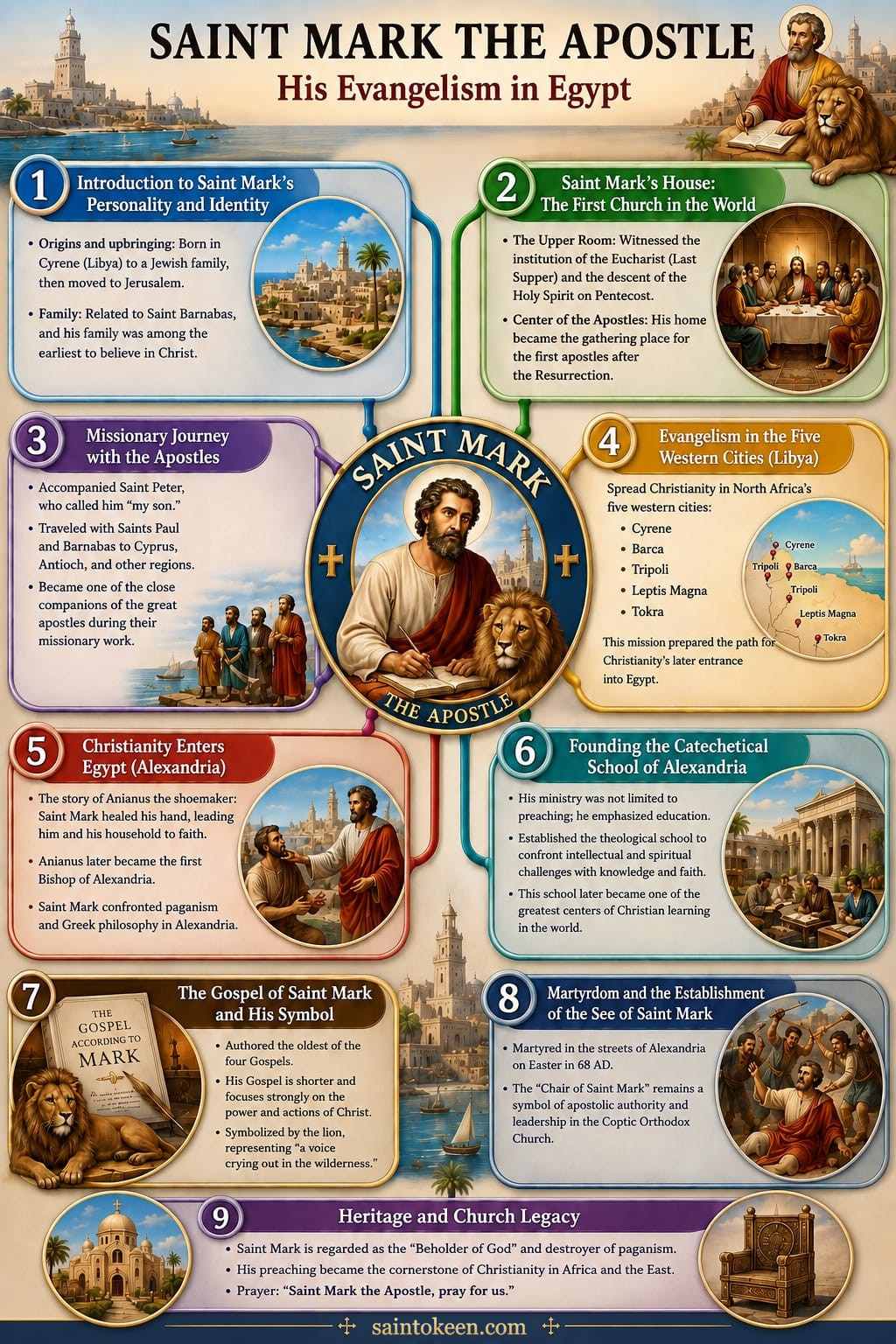
Saint Mark the Apostle, author of the second Gospel, is honoured by the Coptic Orthodox Church as the evangelist of Egypt ("Kerouz" of the land of Egypt) and the first Patriarch of Alexandria. This page gathers what the New Testament says about him, what early Christian writers report, and what the Church of Alexandria has preserved in its tradition — marking which is which.
Each statement is marked by its source: The BibleEarly historical sourceCoptic Orthodox traditionLater development / scholarship
1 Introduction to Saint Mark's Personality and Identity
The Bible The New Testament calls him "John, whose surname was Mark" (Acts 12:12, 25). His mother Mary had a house in Jerusalem where the believers gathered to pray (Acts 12:12).
The Bible St. Paul calls him the cousin of Barnabas (Colossians 4:10; the Greek anepsios means cousin).
Coptic Orthodox tradition The tradition of the Church of Alexandria, recorded in the History of the Patriarchs, says he was born in the Pentapolis of Cyrene in present-day Libya, of a Jewish family, his father named Aristobulus and his mother Mary, and that the family later settled in Jerusalem.
2 Saint Mark's House: The First Church in the World
The Bible When St. Peter was freed from prison, he went to the house of Mary, the mother of John Mark, "where many were gathered together praying" (Acts 12:12). The disciples also met in an upper room in Jerusalem after the Ascension (Acts 1:13).
Coptic Orthodox tradition Church tradition identifies this house with the Upper Room of the Last Supper, of the gathering of the apostles after the Resurrection, and of Pentecost — so honouring it as the first church. The Bible itself does not name the owner of the Upper Room.
3 Missionary Journey with the Apostles
The Bible He went with Barnabas and Saul from Jerusalem to Antioch (Acts 12:25) and was their helper on the first missionary journey in Cyprus (Acts 13:5), then returned to Jerusalem from Perga (Acts 13:13).
The Bible After a disagreement between Paul and Barnabas about him, he sailed with Barnabas to Cyprus (Acts 15:37–39). Later Paul counts him among his fellow workers (Colossians 4:10; Philemon 24) and writes, "he is profitable to me for the ministry" (2 Timothy 4:11). St. Peter calls him "Mark my son" (1 Peter 5:13).
Early historical source Papias, quoted by Eusebius (Church History 3.39), says Mark was the interpreter of Peter and wrote down what Peter taught.
4 Evangelism in the Five Western Cities
Coptic Orthodox tradition Coptic tradition holds that he preached in the Pentapolis, the land of his birth, before and after his coming to Alexandria. For this reason the Coptic Pope still bears the title Patriarch of Alexandria "and the Pentapolis".
Later development / scholarship In classical geography the Pentapolis of Cyrenaica was Cyrene (القيروان), Apollonia (سوسة), Ptolemais — the port of Barca (برقة, Tolmeita), Teuchira (توكرة, Tocra) and Berenice (Benghazi). Tripoli (ancient Oea) and Leptis Magna belonged to Tripolitania further west.
5 Christianity Enters Egypt: Alexandria
Early historical source Eusebius writes that "they say" Mark was the first sent to Egypt, where he preached the Gospel and founded the first churches in Alexandria (Church History 2.16).
Coptic Orthodox tradition The Acts of Mark and the History of the Patriarchs tell that on entering Alexandria his sandal tore; the cobbler Anianus pierced his hand while mending it and cried "God is one". Mark healed the wound in the name of Jesus Christ, preached to him, and baptized Anianus and his household.
Early historical source Anianus became the second Patriarch of Alexandria. Eusebius dates his succession to the eighth year of Nero, about AD 62 (Church History 2.24).
6 Founding the Catechetical School of Alexandria
Early historical source St. Jerome (Lives of Illustrious Men 36) says that a school of Christian teaching existed in Alexandria from the time of Mark the evangelist. Eusebius speaks of a school of sacred learning there "from ancient custom" (Church History 5.10).
Later development / scholarship The school as a known institution appears in the late second century under Pantaenus, and flourished under Clement and Origen. Its fully developed form belongs to those later centuries, while its beginnings are attributed by tradition to Saint Mark.
7 The Gospel of Saint Mark and His Symbol
Early historical source Early writers (Papias, Irenaeus) attribute the second Gospel to Mark, written from the preaching of Peter. It is the shortest of the four Gospels and moves quickly from one deed of the Lord to the next, often with the word "immediately".
Later development / scholarship Many scholars today hold that Mark was the first Gospel written; older tradition placed it second. Both views are held, and the page does not decide between them.
Early historical source The four living creatures of Ezekiel 1:10 and Revelation 4:7 became symbols of the four evangelists. St. Jerome gives the lion to Mark, whose Gospel begins with "the voice of one crying in the wilderness" (Mark 1:3) — the symbol used in Coptic iconography. (St. Irenaeus had given the lion to John.)
8 Martyrdom and the Establishment of the See of Saint Mark
Coptic Orthodox tradition The Acts of Mark relate that the pagans of Alexandria seized him while he celebrated the feast of the Resurrection, dragged him through the streets with a rope around his neck, and that he died the next day. Coptic tradition dates the martyrdom to AD 68 and commemorates it on 30 Parmouti (Baramouda).
Early historical source Eusebius and Jerome place the succession of Anianus — and Jerome the death of Mark — in the eighth year of Nero (about AD 62). This difference in dating is noted here, not resolved.
Coptic Orthodox tradition The Church also commemorates on 30 Paopi (Babah) the consecration of his church and the appearance of his head in Alexandria. From him comes the See of Saint Mark: the Popes of Alexandria count their succession from him as the first patriarch.
9 Heritage and Church Legacy
Coptic Orthodox tradition The Coptic Orthodox Church calls itself the Church of Saint Mark and its patriarch the successor of Saint Mark; His Holiness Pope Tawadros II is the 118th. The Liturgy of Saint Mark, handed down in its Coptic form as the Liturgy of Saint Cyril, is among the oldest liturgies of Alexandria.
Coptic Orthodox tradition His relics: part was taken to Venice in 828, and part was returned by Rome to the Coptic Church in 1968 and rests in Saint Mark's Cathedral at Abbasseya, Cairo; his head is honoured at the Church of Saint Mark in Alexandria.
Sources
- The New Testament: Acts 1:13; 12:12, 25; 13:5, 13; 15:37–39; Colossians 4:10; Philemon 24; 2 Timothy 4:11; 1 Peter 5:13; Mark 1:3
- Eusebius of Caesarea, Church History 2.16, 2.24, 3.39, 5.10
- St. Jerome, Lives of Illustrious Men 8 and 36; Commentary on Matthew, preface
- St. Irenaeus of Lyons, Against Heresies 3.1.1; 3.11.8
- The Acts (Martyrdom) of Saint Mark
- History of the Patriarchs of the Coptic Church of Alexandria (attributed to Sawirus ibn al-Muqaffa')
- The Coptic Synaxarium: 30 Parmouti and 30 Paopi